
Introduction to Logistics And Supply Chain Financial Performance Dashboard
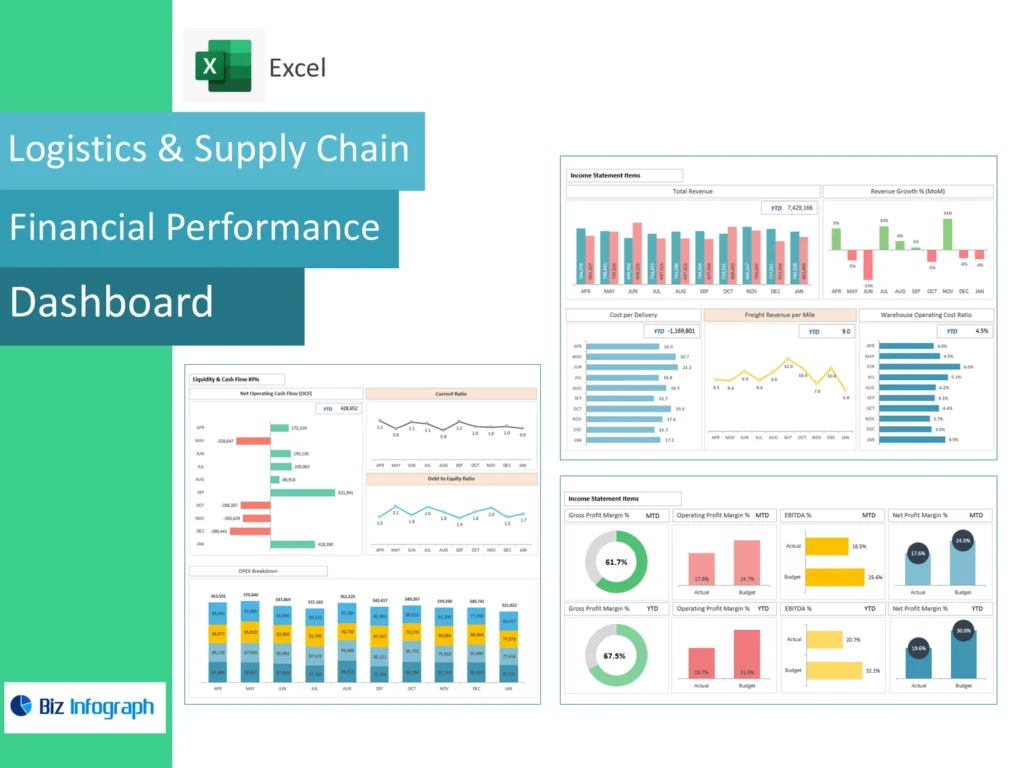
What Is a Logistics & Supply Chain Financial Performance Dashboard and Why It Matters
A Logistics & Supply Chain Financial Performance Dashboard is a reporting tool that helps businesses monitor cost, service, inventory, and supplier performance in one place. It gives leaders a clearer financial and operational view of the entire supply chain instead of forcing them to rely on separate reports. This matters because logistics decisions affect margin, service, and working capital at the same time. A well-built dashboard helps teams understand cost movement, service outcomes, and performance risk more quickly. Better visibility supports stronger planning, tighter control, and more confident supply chain decisions.
How a Supply Chain Dashboard Supports Financial Performance, Cost Control, and KPI Visibility
A strong supply chain dashboard supports financial performance by connecting operational results with cost and efficiency measures. It helps teams monitor logistics costs, service quality, and resource usage in one structured view. This is important because the business needs more than isolated metrics. It needs a broader picture of how the supply chain process affects profitability. A good dashboard highlights key performance indicators, strengthens supply chain visibility, and makes cost trends easier to interpret. That helps managers act earlier and improve both service and financial control across the network.
Why Businesses Use a Logistics And Supply Chain Financial Performance Dashboard Template
Many organizations use a Logistics And Supply Chain Financial Performance Dashboard template because it creates a repeatable structure for recurring review. A strong template can include KPI summaries, cost views, transport measures, and supplier performance without requiring the team to rebuild the report each cycle. This saves time and improves consistency. It also helps teams compare periods more effectively because the same reporting logic is reused. For businesses that need regular financial and operational review, a reusable template is a practical way to improve reporting discipline and make decision-making faster and more dependable.
Core Benefits of Logistics & Supply Chain Financial Performance Dashboard
Improving Financial Visibility Across Logistics and Supply Chain Operations
A strong Logistics And Supply Chain Financial Performance Dashboard improves visibility by combining transport, supplier, inventory, and fulfillment cost information into one report. This helps businesses see how money moves across operations and where pressure is building. Better financial visibility is important because supply chain issues often affect more than service. They also affect cost, margin, and working capital. A clear dashboard supports stronger supply chain efficiency by showing where expenses are rising and where operational changes may improve outcomes. Better visibility supports faster response and stronger financial control across logistics operations.
How KPIs and Performance Indicators Support Better Supply Chain Management
Strong kpis, key kpis, and broader performance indicators help businesses understand whether the supply chain is performing efficiently and cost-effectively. They show how service, inventory, freight, and suppliers are affecting outcomes across the operation. This matters because supply chain management requires decisions that balance cost, service, and reliability. A dashboard that presents these indicators clearly helps leaders and managers focus on what matters most. Better KPI reporting also supports stronger coordination across teams and gives the business a more practical way to improve the performance of the end-to-end supply chain.
Using BI Reporting for Better Logistics Cost and Service Decisions
BI and well-structured reporting help businesses make better cost and service decisions because they turn operational information into something easier to understand and act on. Strong bi dashboards show where service is strong, where cost is rising, and where financial trade-offs are becoming important. This is especially useful in supply chain logistics, where decisions around transportation, warehousing, and suppliers affect both customer performance and cost. Better BI reporting supports faster analysis, stronger planning, and improved control over the financial side of logistics and supply chain operations.
Key Metrics in a Logistics & Supply Chain Financial Performance Dashboard
Essential Key KPIs Every Supply Chain Business Should Track
Every Logistics And Supply Chain Financial Performance Dashboard should include the core key performance indicators that define financial and operational health. These may include cost per shipment, on-time delivery, order cycle time, days inventory outstanding, fill rate, freight utilization, and supplier performance. These are the key supply chain measures that help businesses understand whether the network is both efficient and financially controlled. A good supply chain metrics dashboard makes these metrics easy to review and compare. Clear KPI tracking creates a better basis for both operational control and financial review.
Measuring Freight Cost Per Unit, Cost Per Delivery, and Financial Efficiency
A strong dashboard should clearly measure freight cost per shipment or unit, transportation cost per unit, and delivery cost because these are essential indicators of logistics efficiency. These measures help users understand how transport decisions affect financial performance and whether service is being delivered cost-effectively. Better measurement of cost efficiency also supports margin control and helps the business compare routes, locations, or carriers more accurately. When freight and delivery costs are clearly visible, the dashboard becomes much more useful for financial planning and operational improvement.
Tracking On-Time Delivery, Supplier On-Time Delivery, and Logistics Performance
A good dashboard should track on-time delivery, supplier on-time delivery, and broader logistics performance because these indicators directly affect both service and cost. Late supplier deliveries can disrupt production or fulfillment, while weak transport reliability can hurt customer performance and increase cost pressure. By monitoring these together, the business can better understand where reliability problems are coming from and how they affect outcomes. A strong dashboard connects delivery performance with financial impact, helping teams improve service while also controlling operational inefficiency and avoidable cost.
Supplier and Cost Control in a Supply Chain Dashboard
Using Supplier Views to Monitor Supplier Performance and Delivery Reliability
Supplier reporting is essential because supplier quality and timing influence stock availability, production flow, and downstream service. A strong dashboard should include supplier views that highlight delivery reliability, lead time, and supplier on-time delivery performance in one place. This gives users a more useful way to assess vendor impact and identify weak points in the supply chain. Better supplier visibility also helps the business strengthen sourcing decisions and reduce avoidable disruption. When supplier reporting is clear, it becomes easier to protect service quality and improve the financial stability of operations.
How Freight and Cost Metrics Improve Financial Oversight
Freight and cost reporting improve financial oversight because they reveal where logistics spending is efficient and where it is not. A strong dashboard should show logistics costs, freight trends, route cost patterns, and transport efficiency clearly. This helps leadership understand whether current operating choices are financially sustainable. It also helps teams compare service needs with budget constraints more effectively. When freight and cost metrics are visible in one place, businesses can improve planning, reduce unnecessary spending, and support more disciplined logistics decision-making across the operation.
Connecting Financial KPIs with Supply Chain Service Performance
A strong supply chain report should connect financial KPIs with service performance because these areas are closely linked. High service may come at too high a cost, while lower cost may harm delivery reliability or inventory availability. A dashboard that combines cost, service, and operational indicators helps users understand these trade-offs better. This creates stronger oversight and better decision-making. It also helps teams align financial goals with customer and operational outcomes. Better connection between service and finance makes the dashboard more valuable as a business management tool, not just a reporting display.
Logistics & Supply Chain Financial Performance Dashboard Features
How Logistics & Supply Chain Financial Performance Dashboard Excel Supports Reporting
A Logistics And Supply Chain Financial Performance Dashboard Excel workflow can be useful because many teams still manage cost, shipment, and inventory summaries in spreadsheet-based systems. Excel often acts as the starting point for freight reporting, cost analysis, and operational summaries. When organized well, it can support a practical reporting process and give teams familiar tools for building early-stage dashboards. It also provides a base for companies that are still building maturity in financial and operational reporting. A strong Excel-based workflow can therefore remain useful, especially when supported by structured KPI logic.
Building Better Reports with KPI Layout, Metric Views, and Dashboard Design
Good design matters because dashboards are most useful when they are easy to review and quick to interpret. A strong layout should place the most important KPI summaries first, then show cost trends, supplier views, and operational analysis below. Clear metric views improve usability by helping users focus on what matters most. Better design also makes it easier to compare costs, inventory, and service performance in one report. When dashboard design is thoughtful, the result is a stronger reporting tool that supports faster operational and financial decisions.
Why a Logistics & Supply Chain Financial Performance Dashboard Template Saves Time and Improves Accuracy
A reusable Logistics And Supply Chain Financial Performance Dashboard template saves time by letting teams update data rather than rebuild the same report every period. It also improves accuracy by keeping KPI definitions, layout structure, and cost logic consistent across reviews. This reduces manual reporting errors and helps users trust comparisons more confidently. For organizations managing recurring supply chain reviews, templates are especially practical. They make reporting easier to maintain, reduce repetitive work, and create a more reliable foundation for both executive and operational decision-making.
Practical Use Cases for Financial Performance Reporting
Using Dashboards for Supply Chain Cost Monitoring and Operational Review
A good dashboard is highly useful for daily and monthly cost monitoring because it allows teams to review transport, inventory, and supplier-related expenses in one place. This helps managers understand how operations are performing financially and whether cost trends are improving or worsening. It also supports stronger operational review because users can see the relationship between service quality and financial outcomes. Better cost monitoring improves accountability and gives leadership a clearer view of where savings or corrective actions may be required across the logistics network.
Learning from Supply Chain Dashboard Examples and Types of Supply Chain Dashboards
Reviewing supply chain dashboard examples, examples of supply chain dashboards, and the broader types of supply chain dashboards helps businesses improve the structure and usefulness of their own reports. Good examples show how to organize financial KPIs, service indicators, and supplier measures in a clear and practical order. They also help users understand the types of dashboards that work best for different reporting goals, from executive summaries to daily operational review. Learning from examples reduces design mistakes and helps create stronger dashboards for financial and supply chain performance management.
Applying Financial Performance Reporting to Different Types of Supply Chain Operations
Different operations have different financial reporting needs, so the dashboard should reflect the company’s structure and priorities. For example, some types of supply chain environments focus more on transport cost, while others care more about warehousing, sourcing, or distribution efficiency. A strong financial dashboard should adapt to those differences while maintaining a clear KPI framework. This makes the report more relevant and more useful in practice. Better alignment with the operation helps businesses manage cost, improve service, and strengthen control over performance across different supply chain models.
Dashboard Design and Business Value
Creating Clear Dashboards for Supply Chain Financial and Operational Visibility
A strong dashboard should create clear visibility into both financial and operational performance. It should help users understand not only what costs are rising, but also how transport, inventory, and suppliers are affecting results. This is where dashboards for supply chain become especially valuable. They combine multiple operational perspectives into one working report. Clear visibility improves reporting quality and makes it easier to act on problems quickly. When the financial and operational picture is shown together, users gain a more complete view of the business and can respond with better timing.
Using Key Supply Chain KPIs for Better Cost Control and Decision-Making
A strong report should emphasize the key supply chain KPIs that most directly affect cost and service performance. These KPIs help users understand where cost pressure is increasing, which suppliers are underperforming, and how inventory and transport decisions affect the business. Better KPI visibility supports more informed decisions and stronger cost control across the network. It also helps the organization prioritize attention, especially when multiple issues are happening at once. Better decision-making comes from better reporting, and clear KPI design is one of the most important parts of that process.
Building a Logistics & Supply Chain Financial Performance Dashboard for Different Business Needs
Every business has different logistics and cost priorities, so the dashboard should be flexible enough to reflect those needs. One company may emphasize transportation cost, another may focus on inventory efficiency, and another may care more about supplier reliability or distribution service. A strong Logistics & Supply Chain Financial Performance Dashboard should support these different use cases while maintaining clear KPI logic and financial structure. Good customization improves reporting relevance and helps the dashboard become a more practical tool for daily management and executive review.
Conclusion
Why a Logistics & Supply Chain Financial Performance Dashboard Template Is a Practical Reporting Tool
A Logistics And Supply Chain Financial Performance Dashboard template is practical because it combines consistency, clarity, and efficiency in one reporting structure. It helps teams review cost, service, and supplier performance more reliably while reducing repetitive reporting work. Templates also make comparisons easier across periods or facilities because the same KPI logic is reused each time. For businesses that need recurring financial and operational review, a reusable template offers a stronger foundation for reporting and helps improve the overall quality of supply chain management decisions.
Final Thoughts on Using a Logistics & Supply Chain Financial Performance Dashboard for Financial Performance, Cost Control, and KPI Visibility
A well-designed Logistics & Supply Chain Financial Performance Dashboard helps businesses understand how logistics execution affects financial outcomes. It supports stronger KPI visibility, better cost control, and more useful connections between service and profitability. By turning operational data into clearer financial insight, the dashboard helps organizations improve planning, control expenses, and strengthen performance across the entire supply chain. Better reporting creates better management decisions, and better management decisions help companies improve efficiency, reduce cost pressure, and build stronger supply chain performance over time.
For ready-to-use Dashboard Templates: