
Introduction to Clinical Operations Dashboard
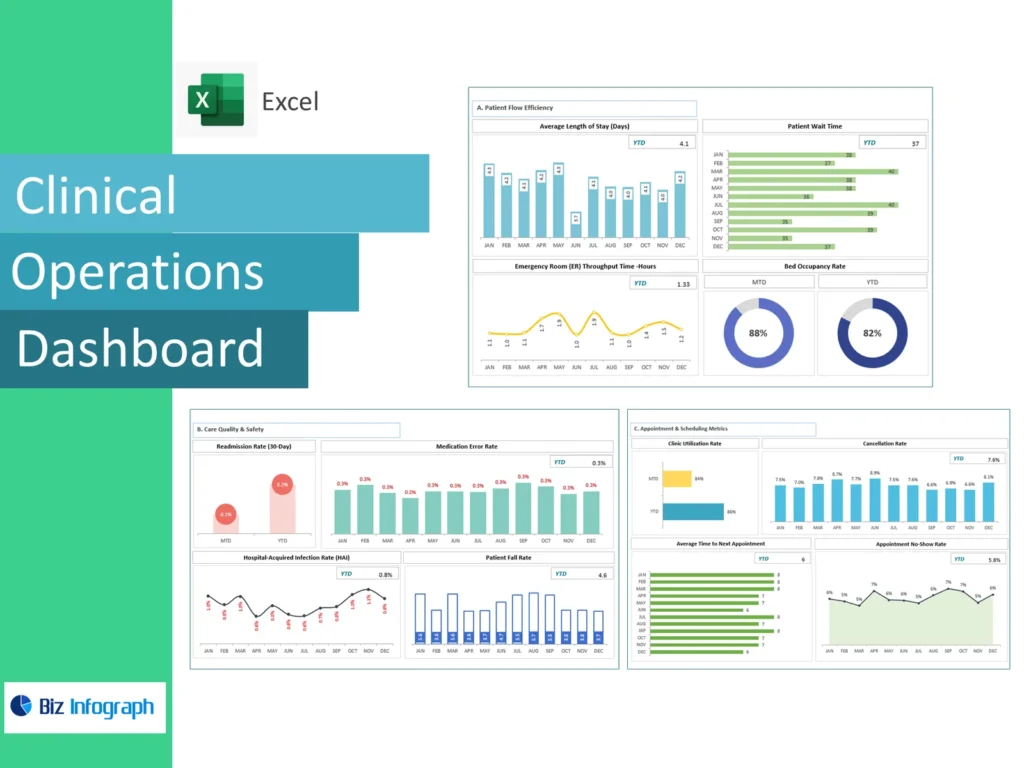
What Is a Clinical Operations Dashboard and Why It Matters
A Clinical Operations Dashboard is a visual reporting tool that helps healthcare organizations monitor service activity, staffing, capacity, and care delivery in one place. It turns clinical and operational information into a structured view that is easier to review than separate reports or spreadsheets. This matters because in modern healthcare, leaders and frontline teams need timely visibility into what is happening across services. A strong dashboard helps transform complex data into actionable insights, supports faster response, and improves how hospitals and clinics manage daily performance, patient flow, and operational priorities.
How a Healthcare Dashboard Supports KPI Tracking and Operational Visibility
A strong healthcare dashboard supports visibility by combining key performance indicators, operational workload, and patient-facing activity into one reporting system. It helps healthcare providers and managers review service demand, throughput, staffing, and quality trends in a more practical way. Better visibility is essential because the healthcare industry depends on coordinated execution across many teams. A useful dashboard makes operational data easier to interpret and helps leaders monitor performance more effectively. This leads to stronger oversight, better coordination, and more confident decision-making across hospitals, clinics, and broader healthcare services.
Why Healthcare Organizations Use a Clinical Operations Dashboard Template
Many organizations use a Clinical Operations Dashboard template because it gives them a repeatable and consistent structure for reporting. A strong template can include service KPIs, capacity views, utilization trends, and operational summaries without requiring teams to redesign the report every cycle. This saves time and improves reporting quality. It also helps healthcare leaders compare results more reliably across periods or departments. For any healthcare organization that needs recurring operational review, a reusable template is a practical way to strengthen reporting and make performance discussions faster and more focused.
Core Benefits of Clinical Operations Dashboard
Improving Operational Visibility Across Clinical and Hospital Operations
A strong Clinical Operations Dashboard improves visibility by bringing together service activity, resource use, throughput, and performance outcomes into one view. This helps leaders understand what is happening across departments without pulling information from multiple files. Better visibility is important because day-to-day operations in hospitals and clinics can change quickly. A well-designed dashboard helps teams spot bottlenecks, capacity issues, and workflow pressure earlier. This supports better oversight across healthcare facilities and improves how managers respond to changes in volume, staffing, and patient flow.
How Analytics and Performance Indicators Support Better Healthcare Decisions
Strong analytics and performance indicators help healthcare teams move beyond basic counts and understand what is driving results. A dashboard can show which services are under strain, where delays are forming, and how clinical demand is affecting operations. This supports more informed decisions because leaders can act on measurable patterns instead of assumptions. Better analytics also help align priorities across departments. When organizations use dashboards well, they improve both service review and healthcare management, creating a stronger connection between data, operations, and organizational performance.
Using Operational Dashboards to Monitor Performance Across Care Teams
Operational dashboards are especially useful because they help care teams and managers review service performance in real time or near real time. A dashboard can show patient volumes, response time, discharge flow, staffing conditions, and departmental workload in a clear format. This makes it easier to understand how one team’s performance affects another. Better team-level visibility supports stronger coordination and faster action. When the dashboard helps teams monitor performance clearly, it improves collaboration, helps reduce operational friction, and strengthens the overall reliability of care delivery.
Key Metrics in a Clinical Operations Dashboard
Essential Clinical and Operational KPIs Every Healthcare Organization Should Track
Every Clinical Operations Dashboard should include the most important key performance indicators needed to understand service performance clearly. These often include patient volume, length of stay, wait time, discharge timing, bed occupancy, staffing coverage, and selected quality measures. These performance metrics help leaders understand whether care delivery and support functions are running effectively. A good dashboard makes these KPIs easy to review at a glance. Clear KPI visibility supports faster management response and helps the organization keep focus on the measures that most affect patient care and operational performance.
Measuring Service Efficiency, Capacity, and Care Delivery Performance Metrics
A useful dashboard should measure how efficiently the organization is delivering care. This includes service throughput, capacity use, patient transitions, appointment flow, and operational timing. These clinical metrics are important because they help leaders understand whether care delivery is keeping pace with demand. A dashboard can also show whether constraints in staffing, rooms, or equipment are reducing performance. Better measurement of service efficiency and capacity helps healthcare teams improve planning, reduce avoidable delays, and strengthen the connection between resource use and care outcomes across a clinical setting.
Using Key Performance Indicators to Monitor Performance and Improve Clinical Operations
A well-built dashboard should help teams use key performance indicators not only to review results, but to improve them. KPI visibility helps managers identify weak spots, compare trends, and follow whether improvement efforts are actually working. This is one of the main reasons a Clinical Operations Dashboard is valuable. When KPIs are visible and consistently defined, the organization can manage workflows more effectively and support stronger operational performance. Better KPI use also improves accountability and helps clinical leaders focus on the issues that matter most to service delivery.
Clinical Operations Dashboard Features
How Clinical Operations Dashboard Excel Supports Reporting
A Clinical Operations Dashboard Excel workflow can still be useful for teams that rely on spreadsheets for reporting extracts, service summaries, and management review. Excel often acts as a familiar starting point for operational reporting, especially when departments are exporting activity or staffing reports from different systems. When structured well, Excel can support practical dashboard summaries and KPI tracking. It also provides a manageable reporting format for smaller teams or early-stage reporting models. A strong Excel-based setup can therefore support visibility while organizations continue developing more advanced reporting capability.
Building Better Reports with Dashboard Design, Metric Views, and Clinical Dashboards
Good dashboard design matters because clinical reporting must be clear, practical, and easy to review under time pressure. A strong report should begin with KPI summaries, then move into service, staffing, and throughput detail below. Well-organized metric views help users understand what is changing and where attention is needed. Better design also improves usability for managers and frontline leaders. Strong clinical dashboards support better interpretation, faster meetings, and more useful performance review. When design is done well, the dashboard becomes a real management tool instead of only a reporting display.
Why a Clinical Operations Dashboard Template Saves Time and Improves Accuracy
A reusable Clinical Operations Dashboard template saves time because it lets teams refresh and review updated data without rebuilding the report each period. It also improves accuracy because the same KPI definitions, chart logic, and report layout are reused consistently. This reduces manual reporting errors and makes comparisons across departments or time periods more dependable. For healthcare teams managing regular performance review, this is a major operational advantage. A strong template supports clearer reporting, faster preparation, and more reliable analysis across hospital and clinical operations.
Clinical and Hospital Reporting Use Cases
Using a Hospital Operations Dashboard for Daily Clinical Monitoring
A hospital operations dashboard is especially valuable for daily monitoring because hospitals need current visibility into patient flow, capacity, staffing, and service pressure. A dashboard can summarize admissions, discharges, length of stay, occupancy, and emergency or inpatient workload in one place. This improves responsiveness because leaders can identify issues before they spread across departments. A good hospital dashboard also helps managers coordinate resources more effectively. Better daily monitoring strengthens hospital management, improves visibility across teams, and supports more stable operations in busy clinical environments.
How a Healthcare Dashboard Helps Care Teams Improve Operational Coordination
A strong healthcare dashboard improves coordination by giving care teams a shared view of workload, status, and operational priorities. Instead of relying on scattered updates, teams can work from one visual summary of what is happening. This is especially useful in a clinical setting where timing, handoffs, and resource use are closely connected. Better coordination helps reduce confusion and improves how teams move patients through services. A good dashboard strengthens communication, supports smoother operational flow, and helps align clinical and non-clinical teams around the same performance picture.
Supporting Better Management Decisions with Clinical Data and Analytics
A strong dashboard supports management by turning clinical data and service trends into something easier to interpret and act on. It can reveal where demand is growing, where delays are forming, and where staffing or process adjustments may be required. Better healthcare analytics also make it easier for leaders to connect operational issues with broader service goals. This leads to better decisions about scheduling, resource allocation, and workflow improvement. When clinical data is presented clearly, management can respond sooner and guide the organization with greater confidence and clarity.
Dashboard Types and Practical Use
Understanding the Main Types of Healthcare Dashboards and Their Uses
There are several main types of healthcare dashboards, and each serves a different purpose. Some focus on operations, others on finance, population trends, service quality, or patient engagement. Understanding the types of healthcare dashboards helps organizations decide which views they need most. For example, an operations dashboard may focus on patient flow, while a finance dashboard emphasizes cost and margin. A care dashboard may support frontline teams, while a broader executive report serves leadership. Knowing these types helps organizations build dashboards that are more relevant and more useful in practice.
Learning from Healthcare Dashboard Examples and Dashboard Examples
Reviewing healthcare dashboard examples and other dashboard examples is one of the most practical ways to improve report design. Strong examples show how to organize KPIs, trends, summaries, and deeper analysis in a way that is easy to understand. They also help teams avoid clutter and weak layouts. Learning from examples supports faster design improvement and makes the final dashboard more useful for real decision-making. Good examples can help healthcare teams create reports that are clearer, more actionable, and better aligned with operational and management needs.
Comparing Clinical Dashboards, Financial Dashboards, and Other Types of Healthcare Dashboards
A Clinical Operations Dashboard is different from financial dashboards and other healthcare reports because it focuses more on service activity, patient flow, operational performance, and workforce readiness. Financial dashboards usually emphasize budgets, costs, and revenue, while a patient dashboard may focus more on the individual care experience. A provider dashboard may be centered on clinician or departmental productivity. Comparing these dashboard types helps organizations understand what each one should do. It also helps ensure the reporting structure fits the intended audience and management objective.
Dashboard Design and Business Value
Creating Clear KPI Views for Clinical Operations and Healthcare Management
Clear KPI views are essential because leaders need a fast and accurate understanding of performance. A good dashboard should show the most important performance data first, then offer supporting details below. This approach helps managers focus on what needs action without getting lost in report complexity. A well-organized dashboard also improves healthcare management by making priorities easier to identify and discuss. Better KPI design strengthens leadership review, improves communication across teams, and helps the organization respond more effectively to operational pressure or changing service demand.
Organizing Healthcare Data for Better Operational Dashboards and Reporting
Good dashboards depend on well-organized healthcare data from relevant systems and operational sources. This may include service records, staffing information, throughput data, patient data, and inputs from electronic health records where appropriate. Strong organization improves reporting quality and makes dashboards easier to trust. It also supports better analysis because users can compare services and trends more confidently. Better data preparation creates stronger operational dashboards and supports more useful reporting across the organization. When the underlying data is clear, the final dashboard becomes much more effective.
Adapting a Clinical Operations Dashboard Template to Different Healthcare Organization Needs
Every healthcare organization has different priorities, so the dashboard should be adapted to reflect those needs. One hospital may focus more on bed flow, while another may prioritize outpatient throughput, surgery coordination, or staffing readiness. Some organizations may also need views related to population health, supply use such as medical supplies, or specific departmental service measures. Adapting the Clinical Operations Dashboard template makes it more relevant and more actionable. Good customization helps ensure the dashboard answers the real operational questions the organization needs to manage most effectively.
Conclusion
Why a Clinical Operations Dashboard Template Is a Practical Reporting Tool
A Clinical Operations Dashboard template is practical because it combines consistency, speed, and clarity in one reporting solution. It helps organizations standardize KPI review, patient satisfaction score, reduce repetitive report-building work, and compare results more reliably across periods or units. Templates also improve reporting quality by keeping the same logic and layout in place. For healthcare organizations that need regular performance review, a reusable template provides a strong reporting foundation and helps teams spend more time interpreting results and less time preparing basic reports.
Final Thoughts on Using a Clinical Operations Dashboard for Healthcare KPI Tracking, Operational Visibility, and Better Performance Monitoring
A well-designed Clinical Operations Dashboard helps healthcare organizations turn operational and clinical information into clearer insight. It improves KPI visibility, supports better coordination, and helps leaders and teams respond faster to changing conditions. By connecting service, care quality, patient satisfaction, staffing, and workflow information in one place, the dashboard supports stronger organizational performance and more effective day-to-day management. In modern healthcare dashboards, the value comes from making performance easier to see and easier to improve. Better reporting leads to better monitoring, stronger control, and more confident healthcare decision-making.
For ready-to-use Dashboard Templates: