
Introduction to Marketing Budget Dashboard Template
What Is a Marketing Budget Dashboard and Why It Matters
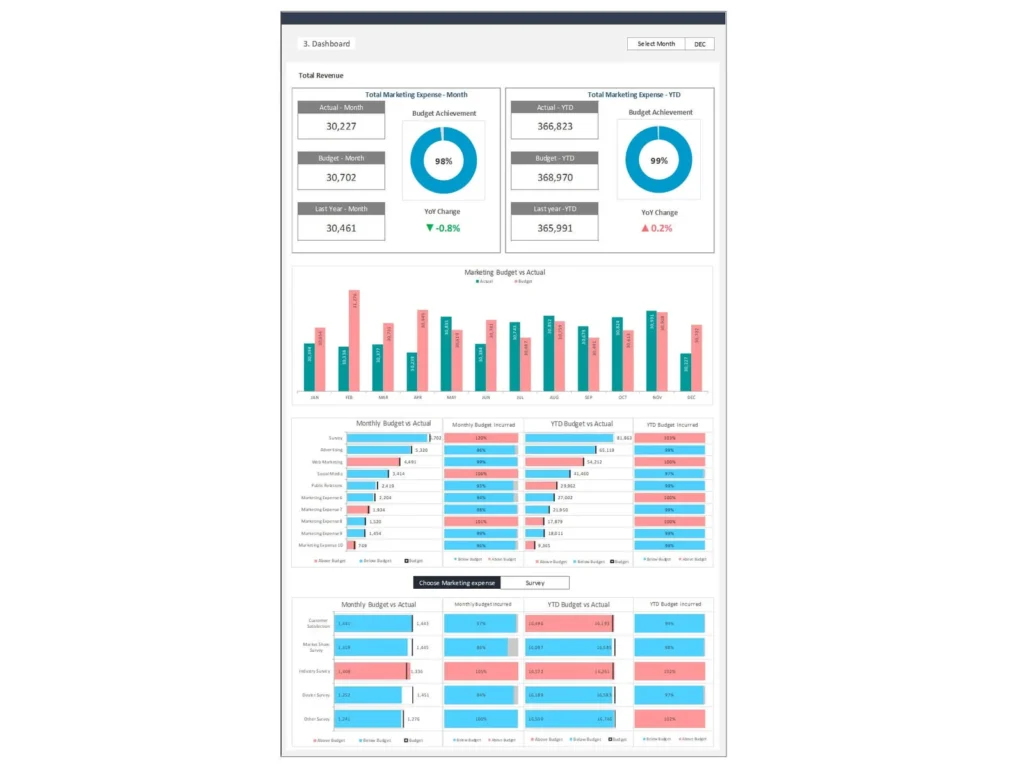
Marketing Budget Dashboard is a centralized reporting tool that helps businesses monitor spending, campaign results, and budget allocation in one place. In simple terms, a marketing dashboard is a visual summary that shows how money is being used across channels and whether that spending is producing results. It helps businesses review marketing expenses, compare performance, and keep attention on the activities that support growth. A strong Marketing Budget Dashboard excel report gives decision-makers better control over planning and execution. Because it connects spend with performance, it offers clearer insights into your marketing and supports more confident budget decisions.
How a Sales Dashboard Style Layout Supports Budget and Campaign Reporting
A Sales Dashboard style layout works well for marketing because it organizes budget, campaign, and performance data into clear sections with charts, cards, and comparisons. This structure helps businesses review spend, lead generation, and channel performance without reading long reports. The dashboard makes complex data easier to understand by using simple visual summaries. It is especially useful when businesses want to connect campaign spend with measurable results. Since the dashboard centralizes key information, it becomes easier to compare channels, review performance, and make better decisions. This type of layout supports both operational detail and high-level management review.
Why Businesses Use a Marketing Budget Dashboard Excel Template
Many businesses prefer a Marketing Budget Dashboard template because it gives them a ready-made framework for tracking budgets and performance. A practical Marketing Budget Dashboard excel file can combine spending data, campaign metrics, and performance charts into one report that is easy to update. This saves time and improves consistency from month to month. For businesses that want better reporting without complex systems, Excel remains an accessible option. A template also helps standardize the reporting structure so managers can compare results more easily. It is a useful way to build a marketing reporting process that supports clarity and discipline.
Core Benefits of a Marketing Budget Dashboard Analytics
Improving Budget Visibility with a Marketing Dashboard
A marketing dashboard improves visibility by showing how funds are distributed across campaigns, channels, and periods. It helps businesses see exactly where money is being spent and whether that spending aligns with priorities. This is important because strong visibility supports better control over marketing investments and reduces the chance of waste. A dashboard can highlight overspending, underused budget areas, and strong-performing channels. Since the dashboard provides a clear summary of allocation and performance, it becomes much easier to manage resources effectively. Better visibility leads to smarter decisions and stronger alignment between strategy and spending.
How Marketing Teams Use Budget Dashboards for Better Planning
A marketing team uses a budget dashboard to review available resources, compare actual spend with plan, and prepare future allocation decisions. This improves planning because the team can see which activities deserve more investment and which ones should be reduced. It also helps connect budget choices with outcomes such as leads, traffic, and conversions. Strong budget reporting supports both short-term campaign adjustments and broader strategic planning. When teams work with a clear dashboard, they can align spending with marketing goals and objectives more effectively. This makes planning more structured and helps improve accountability across the department.
Supporting Effective Marketing Decisions with Clear Metrics and Analytics
A dashboard becomes much more useful when it combines spending data with performance insight. By using clear marketing metrics and analytics, businesses can understand whether campaigns are generating value or just consuming budget. This supports effective marketing decisions because leaders can compare results across platforms, campaigns, and time periods. A dashboard that connects spend with outcomes helps management focus on what actually contributes to growth. It also makes it easier to identify weak areas early and adjust strategy before too much budget is lost. Better analysis leads to better control and stronger decision-making.
Key Metrics in a Marketing Budget Dashboard
Essential Marketing Metrics and Key Performance Indicators to Track
Every Marketing Budget Dashboard should include the most important marketing kpis and spending measures. These often include budget versus actual spend, cost per lead, cost per acquisition, campaign ROI, revenue contribution, and channel-level performance. These metrics help businesses understand how efficiently money is being used. A strong dashboard should also reflect marketing objectives by tracking the numbers most relevant to the company’s goals. Since marketing dashboards typically include both spend and performance indicators, they provide a more complete view of return on investment. Choosing the right metrics is essential for making the dashboard useful.
Using Marketing KPI Dashboard Views for Better Budget Control
A marketing kpi dashboard helps businesses manage performance by highlighting the most important budget and campaign indicators in one view. It can show budget utilization, ROI trends, lead generation, and cost trends alongside broader performance measures. This supports stronger budget control because users do not need to dig through several reports to understand what is happening. A well-designed Marketing Budget Dashboard also makes it easier to explain performance in meetings and adjust strategy quickly. When KPI views are clear and focused, businesses gain stronger oversight and better control over campaign spending and results.
Marketing Budget Dashboard Excel Features
How Marketing Budget Dashboard Excel Simplifies Reporting
A Marketing Budget Dashboard excel file simplifies reporting by organizing raw spend and performance data into one structured workbook. It can summarize channel budgets, campaign outcomes, and key ratios in a clear visual report. This reduces manual effort and improves consistency in marketing reports. Excel is especially useful for businesses that want a flexible reporting format that can be adapted over time. Since many organizations already use spreadsheets, Excel makes dashboard adoption easier. It also allows teams to create custom formulas and views that reflect their real reporting needs. This makes it a practical tool for budget and performance analysis.
Building Better Reports with Dashboard Design, Charts, and Templates
Good dashboard design plays a major role in making reporting easy to understand. A strong dashboard uses charts, KPI cards, tables, and trend lines to present information clearly. This helps managers review campaign performance and budget status quickly. Well-structured visuals improve communication because they turn raw numbers into patterns that are easier to explain. A professional Marketing Budget Dashboard template also saves time by providing a consistent design structure. When businesses use clear design and reusable templates, reporting becomes faster, cleaner, and more useful. Good visuals make the dashboard much more practical for day-to-day management.
Channel and Campaign Budget Analysis
Tracking Digital Marketing Spend Across Campaign Channels
A strong Marketing Budget Dashboard should show how spending is distributed across major channels such as search, social, email, influencer, and display campaigns. This helps businesses compare budget allocation and review the contribution of each area. It is especially important for businesses running multiple online marketing initiatives at once. Channel tracking improves visibility and helps managers understand whether spend is aligned with priorities. It also supports smarter reallocation when a channel is underperforming. For teams managing digital marketing campaigns, this type of analysis makes it easier to stay on top of both cost and performance.
Measuring Email Marketing, Social Media Marketing, and PPC Dashboard Results
Different marketing activities require different performance views. A budget dashboard should include sections for email marketing, social media marketing, and paid campaigns such as a ppc dashboard. These views help teams compare the results of each channel and decide where additional investment makes sense. For example, a business might discover that email produces stronger conversions while paid search creates more awareness. A google ads dashboard can also help track paid campaign performance more closely. Comparing these channels in one dashboard improves planning and helps leaders connect spend with actual value more effectively.
Using SEO Dashboard and Web Analytics Dashboard Insights for Budget Decisions
A dashboard becomes more strategic when it includes performance data from an seo dashboard and web analytics dashboard. Organic search performance, traffic quality, landing page behavior, and website conversion trends all influence budget planning. These metrics help businesses understand whether content, search optimization, and website improvements are contributing to results. When organic performance is strong, budget decisions may shift toward content and search. When website conversion is weak, spend may need to support optimization instead. By combining web and search insight, the dashboard supports stronger decision-making and a more balanced marketing mix.
Marketing Reporting and Performance Review
How a Marketing Reporting Dashboard Supports the Marketing Team
A marketing reporting dashboard gives the marketing team one place to review budget, campaign performance, and progress toward targets. This supports regular reporting, improves team alignment, and reduces time spent preparing manual updates. A central dashboard helps team members understand priorities and compare results across activities. It also makes meetings more productive because everyone refers to the same data. Since the dashboard enables faster review and easier communication, it becomes a practical management tool. For teams balancing several channels and campaigns, a reporting dashboard improves structure and keeps performance discussions focused.
Using Analytics Dashboard Views to Review Campaign and Lead Generation Results
An analytics dashboard helps teams study campaign performance more deeply by comparing traffic, leads, conversions, and engagement across initiatives. This is especially useful for businesses focused on lead generation and channel efficiency. By reviewing how each campaign contributes to pipeline or customer acquisition, teams can judge whether spending is working. These insights improve resource allocation and help leaders understand what drives real business value. A strong digital marketing dashboard can combine campaign results with budget tracking to provide a more complete view. This makes it easier to connect data to action and improve overall performance.
Dashboard Types and Practical Use Cases
Executive Dashboard and CMO Dashboard for High-Level Budget Review
An executive dashboard or cmo dashboard is designed for senior leaders who need a summary of major spending and performance trends without too much detail. These dashboards often include total spend, ROI, lead generation, major campaign results, and channel comparisons. They help leadership understand progress toward annual marketing goals and evaluate whether budget decisions are supporting broader strategy. High-level dashboards are valuable because they make complex reporting easier to review in leadership meetings. They provide a quick but meaningful summary of current performance, which improves oversight and supports faster decision-making.
Digital Marketing Dashboard and Social Media Dashboard for Channel Performance
A digital marketing dashboard is useful when businesses need a combined view of web, social, paid, and content performance. A social media dashboard can provide deeper detail on platform-level activity, audience engagement, and campaign reach. Together, these views help teams manage social media marketing, search, and traffic performance more effectively. They are especially helpful for businesses using multiple channels as part of a larger strategy.
KPI Dashboard and Marketing KPI Dashboard for Ongoing Performance Tracking
A kpi dashboard or marketing kpi dashboard is built for regular performance review. It highlights the most important measures such as spend versus budget, cost per lead, conversions, traffic growth, and ROI. These dashboards support continuous monitoring and help teams stay focused on the indicators that matter most. Because the dashboard tracks progress clearly, it improves accountability and encourages quicker action when performance weakens. Ongoing KPI review also helps businesses stay aligned with marketing goals and objectives. This makes KPI dashboards one of the most useful tools for managing both performance and budget efficiency.
Customization and Business Value
How to Create a Marketing Dashboard for Business Goals
To create a marketing dashboard that is genuinely useful, businesses should begin with their reporting priorities. The dashboard should reflect the company’s marketing goals and objectives, budget categories, and performance expectations. Some organizations may care more about leads, while others focus on brand visibility, conversion, or customer retention. When dashboards are built around actual business goals, they become far more valuable in planning and review. A well-designed Marketing Budget Dashboard helps ensure the team is moving toward marketing priorities with clear visibility into both spending and outcomes.
Choosing the Best Marketing Dashboard for Better Budget Control and Performance
The best marketing dashboard is the one that matches the company’s channels, objectives, and reporting habits. Some businesses may need a simple budget view, while others require a marketing performance dashboard, campaign dashboard, or ecommerce dashboard for deeper analysis. The key is to select a design that gives clear insight without unnecessary complexity. Whether the dashboard is built in Excel or supported by dashboard software, it should make spending and performance easier to understand. Strong dashboard choice improves control, reduces wasted spend, and helps businesses improve marketing performance more consistently.
Conclusion
A Marketing Budget Dashboard template is a practical tool because it combines structure, consistency, and flexibility in one report. It helps businesses monitor marketing expenses, compare campaign results, and keep attention on budget efficiency without creating new reports each cycle. Since the dashboard displays key numbers clearly, it improves communication with both management and operational teams. It also supports better decision-making by linking budget with outcomes. For companies that want dependable and repeatable reporting, a template-based dashboard offers a strong foundation for smarter financial and marketing management.
For ready-to-use Dashboard Templates: