
Understanding the Hospitality and Tourism HR Dashboard
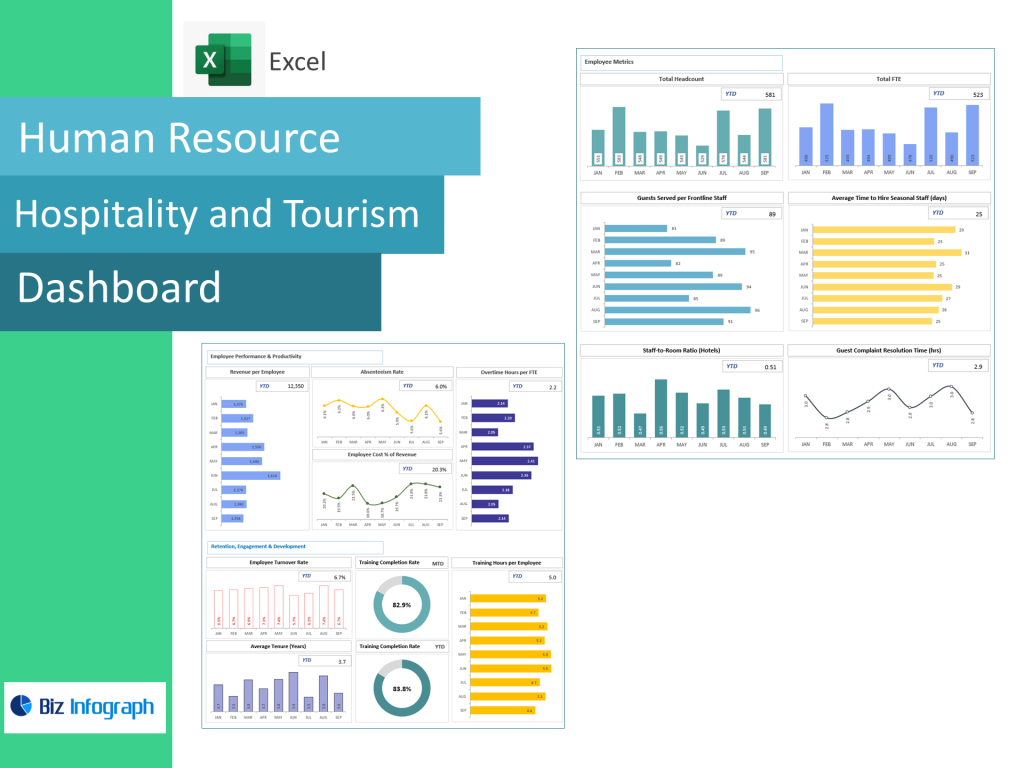
How an HR Dashboard Supports Workforce Management in Hospitality and Tourism
A Hospitality & Tourism HR Dashboard plays a vital role in workforce management across hotels, travel agencies, resorts, restaurants, and tourism service providers. The hospitality industry faces unique challenges such as high employee turnover, seasonal staff fluctuations, varied staffing levels, compliance with labor laws, and the need to support several departments simultaneously—front desk, housekeeping, room service, concierge, kitchen, and marketing teams. A well-designed HR dashboard provides hotel and tourism leaders with a comprehensive view of workforce metrics, enabling data-driven decision-making. This includes monitoring onboarding progress, talent acquisition pipeline, employee satisfaction, absenteeism, and performance reviews, all in one easy-to-understand interface.
A tourism HR dashboard also helps streamline operations by converting raw data into actionable insights. It allows hoteliers to identify staffing shortages during peak occupancy rates or busy restaurant hours, helping the hotel business avoid service disruptions and maintain strong hotel performance. The dashboard allows hotel leaders to hire faster, allocate staff more efficiently, and meet guest expectations consistently. With the dashboard providing real-time workforce planning insights, decision-makers can optimize per employee output, reduce labor costs, and improve the guest experience—ultimately supporting long-term success across the hospitality and tourism sector.
Key KPIs Used in a Hospitality HR Dashboard
A strong hospitality HR dashboard depends on tracking key metrics that reflect employee performance, operational efficiency, and workforce availability. KPIs typically include absenteeism rate, per employee cost, employee satisfaction score, training hours per employee, talent acquisition speed, onboarding completion rate, and performance review outcomes. These KPIs help hospitality businesses evaluate the effectiveness of different staffing strategies and ensure the right employees are in the right roles at the right times. For example, during high occupancy periods, the dashboard helps identify whether additional seasonal staff is needed to maintain service quality in housekeeping or guest dining areas.
In addition to internal HR KPIs, hospitality dashboards often align HR metrics with broader hotel performance indicators—such as occupancy rates, average daily rate (ADR), conversion rate, and revenue per available room (RevPAR). This alignment helps HR teams understand how staffing levels affect the hotel’s financial performance and overall guest satisfaction. A tourism HR dashboard may also track metrics that indirectly affect guest experience, such as NPS (Net Promoter Score), guest complaint categories, and room service delays—highlighting where staffing adjustments can drive measurable improvements. By monitoring KPIs consistently, hotels make strategic workforce decisions that boost efficiency and employee engagement.
Role of a Hotel Dashboard in Enhancing HR Decision-Making
A hotel dashboard enhances HR decision-making by connecting workforce metrics with real hotel performance indicators. In the hospitality industry—where guest experience is directly influenced by staff performance—monitoring labor effectiveness is essential. A hotel dashboard provides a clear view of workforce-related factors affecting operations, such as room turnover speed, front desk efficiency, guest complaint resolution, and restaurant wait times. These metrics help HR leaders understand how staffing decisions contribute to or hinder operational outcomes.
When integrated with a tourism HR dashboard, a hotel dashboard offers deeper insights. For instance, if RevPAR or ADR trends shift due to booking channels or direct booking performance, HR teams can forecast staffing needs more accurately. This helps HR leaders plan ahead for increases in bookings, adjust seasonal staffing levels, or identify roles requiring additional training. The dashboard provides real-time insights into employee performance and service quality, giving hotelier teams the ability to optimize workforce scheduling and reduce service-level gaps. By combining HR data and hotel performance data, decision-making becomes more holistic, strategic, and aligned with business goals.
Core Features and Structure of the HR Dashboard Template
Essential Components Included in a Hospitality & Tourism HR Dashboard Template
A hospitality HR dashboard template is designed to help hotels and tourism companies monitor workforce performance effortlessly. Essential components include staffing level displays, absenteeism tracking panels, per employee cost calculators, and workforce planning tools. The dashboard template often includes recruitment dashboards, training dashboards, and employee satisfaction trackers. These tools allow HR teams to monitor the talent acquisition pipeline, evaluate performance reviews, track employee development, and ensure compliance with labor laws and operational standards.
The template also integrates with existing hotel dashboards to provide a comprehensive view of how HR metrics affect business outcomes. It may include NPS tracking, guest complaint analysis, and time-to-resolution metrics for service-related issues. This alignment helps HR leaders understand how employee performance influences guest experience. Templates built for hotels also include features for managing busy restaurant staffing, room service efficiency, seasonal staffing projections, and marketing team coordination. With an easy-to-use, scalable template, HR teams can simplify workforce analytics and ensure that operations remain efficient regardless of market fluctuations or occupancy changes.
Types of Dashboards Used for HR in Hotels and Tourism
There are several types of dashboards used in the hospitality and tourism industry to support HR functions, each designed to meet different workforce management needs. A recruitment dashboard helps HR teams track candidate pipelines, hiring timelines, and onboarding efficiency. This is particularly important in the hospitality industry, where fast hiring is essential during peak tourism seasons. An employee performance dashboard monitors performance metrics, evaluates training effectiveness, and supports performance reviews across hotel departments.
A tourism HR dashboard focuses on workforce metrics aligned with travel patterns, such as seasonal staffing, staffing needs linked to booking trends, and employee distribution across multiple hotel branches or travel agency locations. A hotel dashboard may also include operational performance dashboards, combining service quality indicators, guest satisfaction scores, and workforce impact metrics. Performance dashboards support daily operations by showing which departments require immediate staffing attention. Together, these dashboards allow HR departments to manage workforce needs comprehensively, improve staffing efficiency, and enhance overall hotel performance.
How a Template Streamlines HR Reporting and Workforce Tracking
An HR dashboard template helps streamline HR reporting by automating data integration and eliminating manual data entry. With easy-to-use, ready-to-fill templates, HR teams can track absenteeism, onboarding stages, employee costs, and staffing levels without building dashboards from scratch. This simplifies reporting processes, enabling HR teams to focus on strategic decision-making instead of manual administrative tasks. Templates also include automated visualizations that make raw data easy to interpret, presenting workforce insights in intuitive charts and performance indicators.
The dashboard template supports workforce tracking by consolidating employment data, room occupancy patterns, booking trends, and staffing schedules. This helps HR leaders predict future staffing needs and assign employees to high-demand areas like front desk operations, room service, or housekeeping. Templates also help HR executives evaluate employee cost per room, cost per service, or cost per guest to align staffing budgets with hotel performance. For hotels and tourism businesses seeking scalability, templates allow updates as the organization grows, helping maintain consistency in reporting and monitoring employee performance over the long term.
HR Dashboard Use Cases in Hospitality Operations
Using the HR Dashboard to Improve Workforce Allocation and Performance
An HR dashboard allows hotels and tourism businesses to allocate employees more effectively across departments. With insights into occupancy rates, busy restaurant periods, booking trends, and room service demand, HR teams can adjust staffing levels to avoid both overstaffing and understaffing. Workforce metrics, such as absenteeism rates and per employee productivity, help HR identify staffing inefficiencies and take corrective actions quickly. By monitoring these metrics, HR leaders ensure that the right staff members are available to support key guest touchpoints.
The dashboard also supports employee development through performance reviews and training analytics. Training hours per employee and development progress indicators help managers ensure that staff remain capable of delivering exceptional service. When guest complaints or low NPS scores highlight performance issues, HR can target training efforts accordingly. This improves guest satisfaction and hotel performance while building a stronger, more effective workforce.
How HR KPIs Support Hotel Dashboard Insights
HR KPIs significantly enhance the effectiveness of hotel dashboard insights by providing context behind operational and financial performance. For instance, low RevPAR or ADR may be partially influenced by inadequate staffing or slow service delivery. When HR KPIs such as absenteeism, performance scores, or staff-to-guest ratios are displayed alongside hotel performance metrics, hotel managers can understand the root causes behind declining guest satisfaction or operational inefficiencies.
HR KPIs such as onboarding completion rates, training participation, and employee satisfaction also affect long-term employee retention. High turnover often leads to inconsistent guest experience, lower service quality, and increased training costs. By monitoring HR KPIs with hotel performance metrics, hospitality dashboards empower hotel managers to take corrective actions quickly—such as increasing training for new staff or implementing retention strategies. The integration of HR KPIs with hotel dashboards strengthens overall management strategies.
Integrating Multiple Dashboard Types for Complete Workforce Visibility
Integrating multiple dashboard types—HR dashboards, hotel dashboards, tourism HR dashboards, and performance dashboards—provides a complete picture of workforce impacts across hospitality operations. When combined, these dashboards offer a comprehensive view of employee performance, operational efficiency, guest satisfaction, and financial outcomes. This holistic integration allows HR and hotel management to connect staffing levels with occupancy trends, service quality, and revenue outcomes.
For example, if occupancy rates rise due to direct booking success or marketing campaigns, workforce planning dashboards ensure adequate staffing across housekeeping and front desk operations. Similarly, if a travel agency sees a surge in bookings for specific tour packages, HR dashboards help managers allocate the right staff to meet demand. Integrating dashboard examples provides clarity and consistency, improving workforce management across diverse touchpoints. Together, these dashboards help hospitality businesses streamline operations, improve employee satisfaction, and enhance guest experience, ultimately supporting long-term growth and profitability
For ready-to-use Dashboard Templates: