
Overview of the FMCG Sector HR Dashboard
What an FMCG Dashboard Is and Its Role in FMCG Businesses
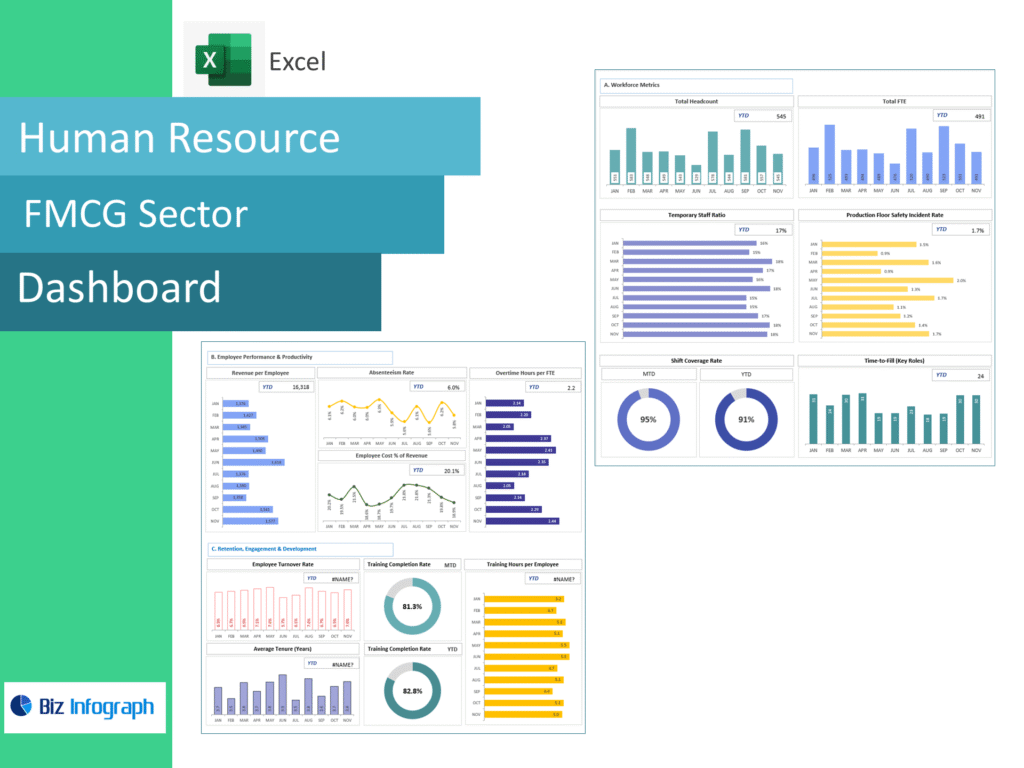
An FMCG sector HR dashboard is a centralized dashboard designed to support workforce planning, performance monitoring, and decision-making in fast-moving consumer goods businesses. In FMCG companies, operations move quickly across sales, supply chain, distribution, and retail networks, making workforce visibility essential. An FMCG dashboard consolidates HR data from multiple systems into a single, accessible view, helping management understand how people performance impacts business outcomes.
This dashboard plays a critical role by linking workforce data with operational and sales performance. It provides insight into staffing levels, productivity, and operational readiness across the FMCG sector. By offering real-time visibility into workforce metrics, the dashboard supports informed decisions that align human resources with demand fluctuations, market conditions, and brand growth objectives. For FMCG businesses operating at scale, this dashboard becomes a strategic enabler rather than just a reporting tool.
How an HR Dashboard Supports Management and Strategic Overview
An HR dashboard supports management by delivering a strategic overview of workforce performance across the organization. FMCG leaders need to understand how teams contribute to sales, supply chain efficiency, and overall operations. The dashboard enables management to monitor KPIs related to workforce productivity, absenteeism, and team performance in one place.
This strategic overview helps leaders align workforce planning with business goals such as revenue growth, pricing strategies, and market expansion. By visualizing performance metrics across units and functions, management can identify gaps and optimize resource allocation. The dashboard also supports executive reporting by translating complex HR data into clear insights that inform strategic decisions. In the FMCG sector, where speed and accuracy matter, this level of visibility strengthens leadership effectiveness.
Using Data and Intelligence for Workforce Overview
Data and intelligence are the foundation of an effective FMCG HR dashboard. By integrating data from HR systems, operational platforms, and sales systems, the dashboard provides a comprehensive workforce overview. This intelligence enables organizations to understand how workforce dynamics affect operational performance and market responsiveness.
Through analytics and BI capabilities, the dashboard transforms raw data into actionable insight. It highlights trends in workforce availability, productivity, and performance across teams and locations. This workforce overview supports proactive decision-making and reduces reliance on manual reporting. By leveraging data intelligence, FMCG businesses gain the clarity needed to manage fast-moving operations efficiently.
Performance, Teams, and Workforce Management
Monitoring Team Performance Across FMCG Companies
Monitoring team performance is essential in FMCG companies, where sales teams, warehouse teams, and distribution units operate under constant pressure. An HR dashboard enables continuous monitoring of team performance using relevant performance metrics and KPIs. These metrics provide insight into productivity, efficiency, and workforce utilization across functions.
By visualizing team performance data, the dashboard helps management identify high-performing teams and areas requiring support. This visibility allows for timely interventions, training, or staffing adjustments. Monitoring team performance through a dashboard ensures alignment between workforce efforts and operational objectives, supporting consistent execution across the FMCG sector.
Linking Sales, Distribution, and Workforce Performance
In FMCG businesses, workforce performance is closely tied to sales and distribution outcomes. The FMCG HR dashboard links workforce metrics with sales performance, enabling organizations to understand how staffing levels and skills impact revenue and market coverage. This linkage is particularly important for sales teams operating in competitive markets.
By integrating sales and distribution data, the dashboard provides insight into how workforce decisions affect demand fulfillment and customer satisfaction. Management can analyze performance across sales units and distribution networks, optimizing staffing strategies accordingly. This integrated view supports data-driven decisions that enhance both workforce efficiency and commercial performance.
Supporting Operational Performance Through HR Data
HR data plays a vital role in supporting operational performance in the FMCG sector. The dashboard consolidates HR metrics with operational data, enabling organizations to assess workforce readiness and productivity. This support is critical for managing fast-moving operations where delays or shortages can impact revenue.
By monitoring HR data in real time, organizations can respond quickly to operational challenges. The dashboard helps ensure that staffing levels align with demand patterns and operational requirements. This proactive approach improves operational resilience and supports consistent service delivery across the FMCG value chain.
Analytics, BI, and Data-Driven Decisions
Using Analytics to Enable Data-Driven Decisions in FMCG
Analytics is a key enabler of data-driven decisions in FMCG HR management. An FMCG HR dashboard leverages analytics to analyze workforce trends, performance metrics, and operational outcomes. These insights help leaders understand patterns and correlations that influence business performance.
By using analytics, the dashboard supports evidence-based decision-making rather than intuition. Leaders can assess the impact of workforce changes on sales, supply chain efficiency, and brand performance. This analytical approach enhances competitiveness and supports sustainable growth in the FMCG sector.
How HR Data Supports Strategic Decision-Making
HR data supports strategic decision-making by providing visibility into workforce capabilities and constraints. The dashboard integrates HR data with business metrics, enabling leaders to evaluate how people-related decisions affect strategic objectives such as market expansion or revenue growth.
This strategic perspective helps FMCG companies align workforce planning with long-term goals. By analyzing HR data alongside market and operational data, organizations can make informed decisions that balance cost, performance, and growth. The dashboard thus becomes a strategic tool for leadership.
Turning Workforce Data into Actionable Intelligence
Turning workforce data into actionable intelligence is a core function of the FMCG HR dashboard. Through BI and analytics, the dashboard converts data into insights that guide action. These insights highlight risks, opportunities, and performance gaps across teams and functions.
Actionable intelligence enables FMCG leaders to optimize workforce strategies, improve productivity, and enhance operational efficiency. By delivering timely insights, the dashboard supports agile responses to changing market and operational conditions. This capability is essential in fast-moving FMCG environments.
HR Support for Supply Chain, Warehouse, and Retail Operations
Workforce Support for Supply Chain and Distribution Operations
Supply chain and distribution operations depend heavily on workforce performance. The HR dashboard supports these operations by providing visibility into staffing levels, skills, and productivity across supply chain units. This support ensures that workforce availability aligns with demand and operational schedules.
By integrating supply chain data with HR metrics, the dashboard helps identify bottlenecks and optimize resource allocation. This alignment improves efficiency and reduces disruptions, supporting reliable product delivery and customer satisfaction.
Managing Warehouse and Retail Teams Using HR Dashboards
Warehouse and retail teams are critical components of FMCG operations. The HR dashboard enables management to monitor performance metrics such as productivity, attendance, and turnover for these teams. This monitoring supports effective workforce management in high-volume, fast-paced environments.
By providing real-time visibility, the dashboard allows managers to address issues proactively and maintain operational continuity. This capability is especially valuable during demand spikes or promotional periods. Effective management of warehouse and retail teams enhances overall supply chain performance.
Ensuring Workforce Alignment Across the FMCG Network
Ensuring workforce alignment across the FMCG network is essential for consistent execution. The HR dashboard provides a unified view of workforce data across locations, functions, and brands. This alignment supports standardized processes and performance expectations.
By monitoring workforce metrics across the network, organizations can ensure consistency and fairness. The dashboard helps align HR strategies with operational and commercial goals, strengthening coordination across the FMCG ecosystem.
Systems, Templates, and Dashboard Implementation
Using a Dashboard Template for FMCG HR Management
A dashboard template simplifies FMCG HR dashboard implementation by providing predefined structures and metrics. Templates reduce setup time and ensure consistency in reporting. They are particularly useful for organizations scaling HR analytics capabilities.
By using templates, FMCG companies can deploy dashboards quickly and focus on analysis rather than design. Templates support standardization and improve adoption across teams.
Integrating HR Systems with FMCG Operational Data
Integration of HR systems with FMCG operational data is critical for dashboard effectiveness. The HR dashboard unifies data from HR systems, sales platforms, and supply chain systems into a single view. This integration ensures data accuracy and completeness.
By connecting data sources, the dashboard provides comprehensive insight into workforce and operational performance. This integration supports informed decision-making and reduces data silos.
Delivering Strategic and Operational Support Through HR Dashboards
Ultimately, FMCG HR dashboards deliver both strategic and operational support. They empower management with insights that drive performance, optimize operations, and support business growth.
By combining analytics, real-time data, and performance metrics, the dashboard becomes a critical tool for managing people in the fast-moving FMCG sector.
Conclusion
An FMCG Sector HR Dashboard is essential for aligning workforce performance with sales, supply chain, and operational objectives. By transforming HR data into actionable insight, dashboards enable FMCG companies to make data-driven decisions, optimize performance, and sustain competitive advantage.
For ready-to-use Dashboard Templates: