
Understanding a Financial Services Sector Dashboard
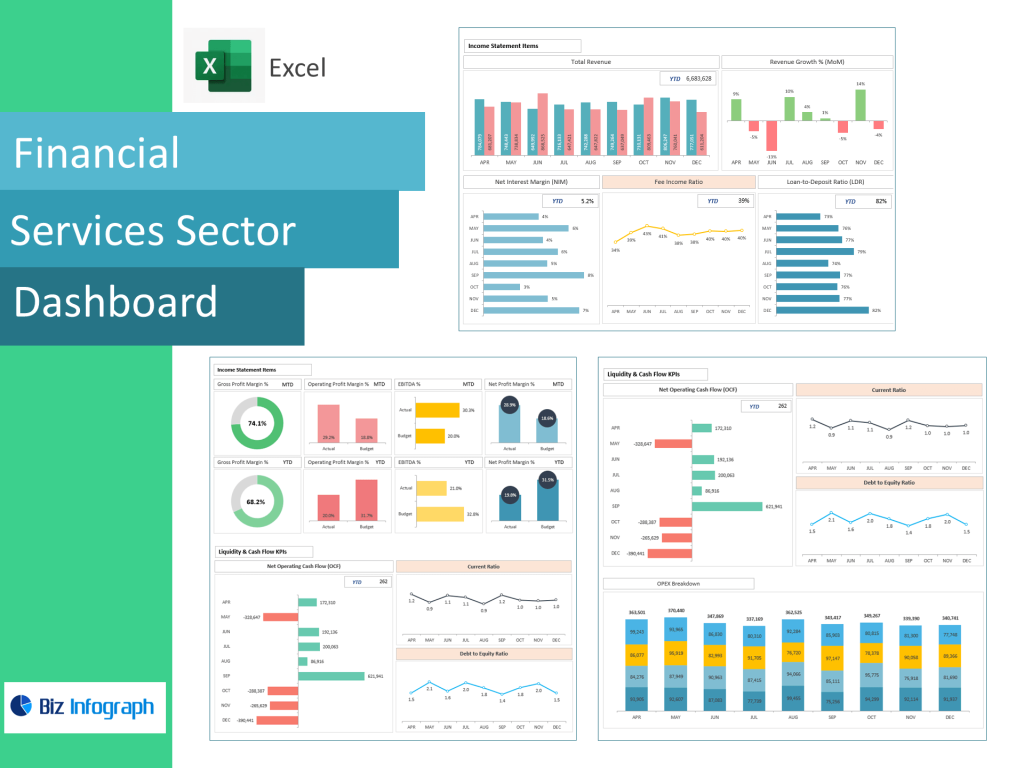
How a Dashboard Helps Financial Institutions Track Key Financial Data
A financial services sector dashboard serves as a centralized visualization hub for monitoring financial health, risk position, revenue flow, and operational performance. Financial dashboards help finance professionals track key financial metrics such as liquidity ratios, cash flow trends, market exposure, margin changes, and overall business performance. The dashboard can provide real-time reporting to highlight fluctuations in investment returns or credit performance. Because financial dashboards provide data in a structured, visual format, decision-makers gain rapid insight into the health of your business without sifting through spreadsheets or complex financial statements. For financial institutions, this simplifies workflow and strengthens data analysis accuracy. A finance dashboard also reduces reporting time, improves transparency, and becomes the foundation for performance management. Ultimately, a dashboard helps teams visualize risk, evaluate profitability, and connect strategy with outcome—allowing leaders to make informed decisions that improve financial stability and long-term financial success.
Financial Dashboard Example Showing a Complete Financial Picture
A strong financial dashboard example brings together both financial and operational data, offering a complete financial picture of the organization. This type of dashboard gives finance teams visibility into revenue streams, expense breakdowns, capital allocation, loan portfolios, and cost-to-income ratio. An executive dashboard layered over deeper reporting dashboards allows each user level to see relevant information based on their role. The best financial dashboard combines high-level summaries with drill-down capability so users can analyse departmental, regional, or product-based performance metrics. This helps organizations evaluate financial success based on the performance of key areas. When designed well, a modern financial dashboard makes it easy to understand financial outcomes and align them with strategic targets. Financial dashboards help make critical planning decisions by showing actuals vs. forecasts, enabling teams to refine budgets and resource allocation. With a dashboard serving as a financial and business intelligence tool, leaders maintain a clear view of future performance trajectories and take actions before risks materialize.
What Metrics a Financial Dashboard Should Display for Accurate Insight
Choosing the right metrics you should include is essential for creating an effective finance dashboard. Key financial metrics often shown include revenue growth, margin percentage, expense ratio, working capital availability, accounts receivable aging, asset turnover, and cost-of-debt indicators. Financial dashboards provide value when core performance metrics are combined with supporting operational insights such as staffing efficiency, marketing ROI, and sales funnel velocity. These metrics align with business goals, making it easier to evaluate organization’s financial performance. Because the dashboard contains both financial and non-financial measures, leadership sees not only how the business performed but why. Financial dashboards make monitoring easy by converting raw financial information into visual trends and variance highlighting. Dashboards enable real-time assessment of changes, allowing finance professionals to redirect resources or modify pricing strategy quickly. These essential financial Key Performance Indicators ensure that reporting remains data-driven, accurate, and strategically valuable.
Improving Reporting and Analysis Through Financial Dashboards
Financial Reporting and Analytics for Clear, Real-Time Insight
A financial reporting dashboard supports the reporting process by automating updates and centralizing audit-ready numbers. Financial reporting dashboards enable real-time reporting, eliminating manual aggregation from PDFs or accounting exports. This empowers organizations to interpret results faster and accelerate closing cycles. Financial dashboards help finance teams analyze variances between planned and actual performance, exposing revenue softness or cost overruns at their root. They also offer year-over-year comparisons, expense category heat-mapping, and rolling forecasts. Financial analytics powered dashboard software transforms static reporting into dynamic business intelligence. With interactive dashboards, professionals conduct scenario modeling, stress testing, or break-even forecasting instantly. As a result, financial teams save time, reduce reporting errors, and enhance financial decision-making speed and quality.
How Financial Dashboards Help Make Better Business Decisions
Financial services sector dashboards help make better business decisions by connecting performance metrics with strategic direction. A dashboard gives leadership a dynamic view of capital efficiency, portfolio behavior, underwriting strength, and long-term asset growth. When paired with financial analysis models, dashboards make data-driven decisions easier because all necessary context is visible in one interface. A financial performance dashboard links budget consumption to project outcomes, showing ROI-based prioritization pathways. Financial dashboards help management evaluate whether projects reinforce financial goals or require adjustment. When leadership sees how decisions affect bottom-line outcomes, strategic decisions align more closely with future performance objectives. Ultimately, financial dashboards help organizations act confidently, respond faster, and deploy resources with precision.
Using a Data-Driven Dashboard to Improve Financial Transparency
Financial dashboards provide transparency across departments by turning financial data into accessible visual frames. A dashboard is a visual overview of revenue, cost, risk, and growth potential—enabling departments beyond finance to understand financial drivers. A data-driven dashboard increases accountability since results and variances are visible to everyone, not just analysts. Reporting dashboards can highlight cash-burn velocity, treasury strength, and major cost contributors without requiring spreadsheet navigation. Transparency builds stronger decision alignment within teams and enables consistent financial management practices. As real-time dashboards update continuously, gaps in revenue or control surfaces faster, allowing teams to adjust strategy immediately. Greater transparency leads to more accurate planning, improved stewardship, and stronger investor confidence.
Metrics and KPIs to Monitor in Financial Dashboards
Core Metric Categories That Drive Better Interpretation
The most effective financial dashboards monitor revenue-centric, cost-centric, liquidity-centric, and risk-centric KPI families. Core categories include income vs. spend, asset turnover, EBITDA margin, cash flow solvency, and forecast accuracy. Financial dashboards provide clarity especially when KPIs are benchmarked against industry standards. Performance metrics show progress over time, enabling organizations to evaluate movement toward financial goals. A financial dashboard gives a multi-dimensional view by connecting expense shifts to sales velocity and cost changes to market dynamics. Monitoring these categories makes it easy to understand whether strategies are yielding profit expansion or needing revision. Core KPIs thus shape how business decisions are made and how future financial modeling is structured.
Using Metrics to Strengthen Insight and Decision-Making
Metrics support insight beyond basic numerical reporting because they reveal patterns and direction. Financial dashboards help professionals see trend escalation, profit leakage, currency exposure, or cost surges early enough to intervene. A financial dashboard gives risk-mitigation awareness by linking market shifts to sensitivity indicators. The dashboard contains historical performance, rolling averages, and projected outcomes, helping finance professionals track deviations meaningfully. These insights strengthen strategic decision-making by clarifying which levers control profitability or resilience.
Why Interactive Dashboards Make Data-Driven Decisions Easier
Interactive dashboards allow teams to drill-down by branch, asset class, time period, or revenue category with a click. Dynamic filters make it easy to analyze cause-effect relationships rather than static numbers alone. Financial dashboards make live meetings more productive because insights update instantly rather than requiring offline extraction. A modern financial dashboard enables fast what-if simulation, volume segmentation, or scenario mapping. This reduces decision friction and accelerates planning.
Dashboard Tools for Financial Institutions
Financial Dashboards Help Institutions Manage Risk and Performance
Financial dashboards help institutions manage portfolio risk, liquidity stability, and net-interest revenue performance. The dashboard helps monitor delinquency rates, credit distribution, and regulatory capital buffers. When used alongside risk analytics, performance management improves because threats are visible sooner. A financial dashboard gives both financial and operational indicators, reducing exposure and maximizing compliance.
Interactive Dashboards Supporting Strategic Financial Insight
Interactive dashboards enhance analysis through drill-through reports, dynamic charts, and real-time visualization. Dashboards make it simple to evaluate health of your business at a strategic layer. Executive dashboards highlight milestone progression while operational dashboards validate execution quality. When the dashboard provides interactive elements, finance professionals move from reactive analysis to proactive strategy.
How Financial Dashboards Help Make Real-Time Data-Driven Decisions
Real-time dashboards enable leadership to make data-driven decisions by removing dependency on month-end closing cycles. When financial and non-financial signals feed directly into dashboard software, organizations increasingly respond at opportunity speed. A financial dashboard gives fast clarity on revenue drops or cash restrictions. This responsiveness accelerates growth potential, secures stability, and enhances strategic execution success.
For ready-to-use Dashboard Templates: