
Understanding the Commercial, Supply Chain and RAndD Performance Dashboard
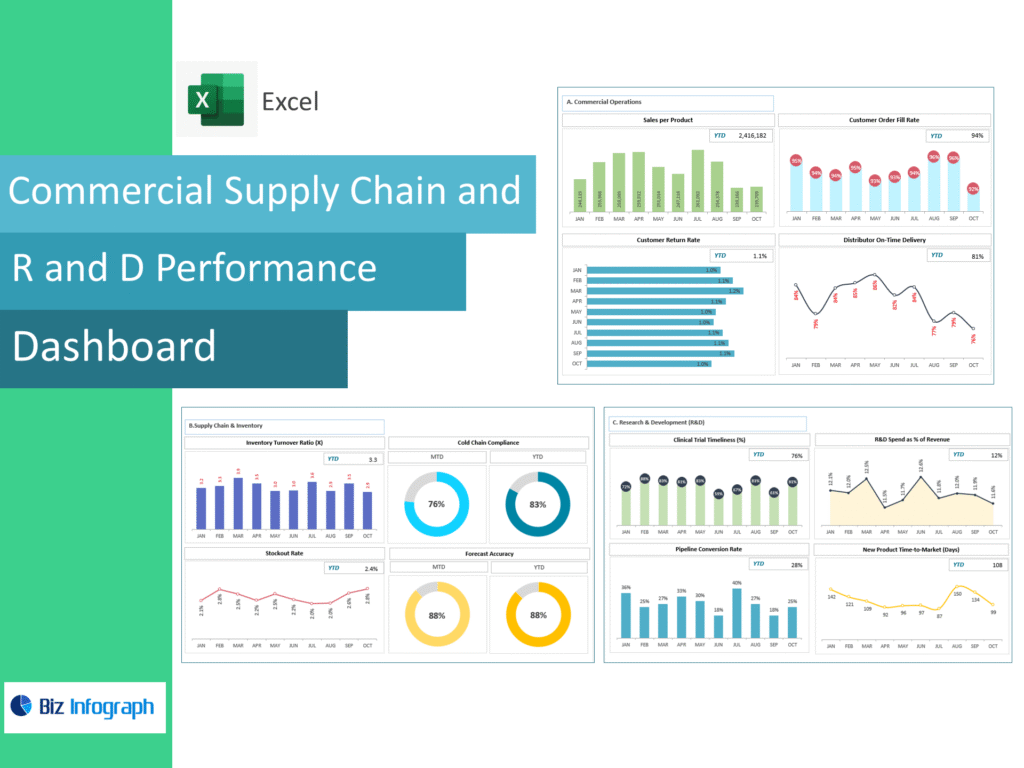
What a Supply Chain Dashboard Is and How It Supports Performance Monitoring
A supply chain dashboard is a centralized dashboard that consolidates data from procurement, logistics, warehouse management, and R&D-related supply activities into a single performance monitoring view. In a commercial supply chain and R&D performance dashboard, this visibility is essential to understand how research outputs, sourcing decisions, and operational execution interact across the entire supply chain. The dashboard provides a clear view of key metrics such as delivery time, stock levels, order accuracy, and fulfillment rates, enabling organizations to monitor performance consistently.
A supply chain dashboard helps teams track performance indicators across multiple data sources, including ERP systems and supplier platforms. By offering accurate and up-to-date insights, the dashboard supports proactive monitoring and faster decisions. It replaces fragmented reports with a comprehensive view that allows leaders to spot bottlenecks, monitor variance, and improve operational efficiency across the entire supply chain.
Role of a Performance Dashboard in Commercial and R&D Planning
A performance dashboard plays a strategic role in aligning commercial operations with R&D planning. R&D initiatives often depend on supplier reliability, procurement timelines, and material availability, making integrated performance visibility critical. The dashboard provides real-time insights into supplier performance, inventory value, and demand forecasts, ensuring that R&D planning aligns with commercial realities.
By tracking performance indicators such as cost per unit, delivery time, and supplier quality, dashboards help organizations benchmark results and identify improvement opportunities. Dashboards help commercial and R&D teams make data-driven decisions by transforming complex operational data into clear insights. This alignment reduces disruption, improves customer satisfaction, and ensures that innovation pipelines remain future-proof and operationally viable.
Using a Planning Dashboard for End-to-End Visibility
A planning dashboard delivers end-to-end visibility across procurement, production, warehousing, and distribution. For commercial supply chains supporting R&D, this visibility is essential to balance innovation timelines with operational constraints. The dashboard provides real-time visibility into demand planning, stock levels, backorders, and overstock situations across warehouses.
By integrating demand forecasts and supplier data, planning dashboards help teams proactively manage inventory and avoid disruptions. The ability to track percentage of customer demand met without delays ensures alignment between planning and execution. This comprehensive view enables organizations to coordinate activities across functions, improving responsiveness and operational efficiency while supporting long-term planning objectives.
KPIs, Metrics, and Performance Measurement
Key Metrics Tracked in a Supply Chain Performance Dashboard
A supply chain performance dashboard focuses on key metrics that reflect efficiency, reliability, and responsiveness. These include fulfillment rates, order accuracy, delivery time, inventory value, and cost per transaction. For commercial and R&D environments, metrics also cover supplier reliability, supplier quality, and variance between planned and actual outcomes.
Tracking these metrics consistently helps organizations identify trends and performance gaps. Dashboards transform raw operational data into data into clear insights, enabling leaders to monitor performance across the entire supply chain. By focusing on metrics that matter, organizations ensure that performance measurement drives meaningful improvement rather than superficial reporting.
Supply Chain KPIs and KPI Dashboard for Performance Management
A KPI dashboard provides a structured approach to performance management by visualizing supply chain KPIs in one place. Common metrics include percentage of customer demand met, fulfillment rates, inventory turnover, and freight efficiency. These KPIs help organizations assess whether supply chain operations support commercial and R&D goals.
Dashboards help teams track supplier performance and benchmark results over time. By using KPIs consistently, organizations improve accountability and transparency. The KPI dashboard also supports faster decisions by providing accurate and up-to-date data that leaders can trust.
Measuring Fill Rate and Other Critical Performance Indicators
Fill rate is a critical indicator of supply chain effectiveness, representing the percentage of customer demand met without backorders. Alongside fill rate, dashboards track order accuracy, delivery reliability, and backorders to assess service performance. These indicators directly impact customer satisfaction and revenue stability.
Dashboards allow teams to analyze fill rate trends and identify root causes of shortfalls, such as supplier delays or warehouse constraints. By monitoring these indicators proactively, organizations can improve service levels and reduce operational risk across the entire supply chain.
Analytics and Data-Driven Insights
Using Analytics to Monitor Supply Chain and R&D Performance
Analytics play a central role in transforming dashboards into strategic tools. By applying analytics to supply chain data, organizations can identify patterns, correlations, and risks affecting both commercial and R&D performance. Analytics dashboards support monitoring of supplier performance, inventory trends, and logistics efficiency.
These insights enable proactive management of disruption risks and help organizations optimize processes. Analytics-driven dashboards help teams understand the impact of procurement and planning decisions, supporting continuous improvement and innovation.
How Analytics Enhances KPI Tracking and Decision-Making
Analytics enhance KPI tracking by adding context and predictive capability to performance measurement. Instead of simply reporting past results, dashboards analyze variance and trends to support better decisions. For example, analytics can highlight emerging overstock risks or declining supplier reliability.
By enabling data-driven decisions, analytics dashboards empower leaders to act proactively rather than reactively. This capability improves operational efficiency and ensures that performance management supports strategic objectives.
Turning Metrics into Actionable Performance Insights
The true value of a dashboard lies in its ability to turn metrics into actionable insights. Dashboards combine visualization, analytics, and real-time data to help users spot bottlenecks and prioritize actions. This transformation supports faster decisions and continuous improvement.
By providing a clear view of performance indicators, dashboards help teams focus on what matters most. Actionable insights enable proactive management of supply chain challenges and support sustainable performance improvements.
Dashboard Templates and Practical Use
Using a Dashboard Template to Build a Supply Chain Dashboard
A dashboard template accelerates the process to create dashboards by offering predefined layouts and metrics. Templates are especially valuable for teams using an Excel template or drag-and-drop dashboard tools, as they reduce setup time and complexity.
Templates ensure consistency in KPI definitions and reporting standards. By using templates, organizations can quickly deploy dashboards that deliver value and support performance management without extensive customization.
Performance Dashboard Templates for Commercial and R&D Teams
Performance dashboard templates tailored for commercial and R&D teams include metrics related to procurement, demand planning, and supplier performance. These templates support collaboration by providing shared views of performance.
Templates also enable scalability, allowing dashboards to evolve as business needs change. By standardizing performance measurement, templates help teams align around common goals and metrics.
Aligning Dashboard Design with Key Metrics and KPIs
Effective dashboard design focuses on clarity and relevance. Dashboards should highlight key metrics and KPIs that align with business objectives. By aligning design with metrics that matter, dashboards support informed decision-making.
Design considerations include usability, accessibility, and visualization clarity. Well-designed dashboards make it easier for users to interpret data and take action.
Optimizing Performance with Supply Chain Dashboards
How a Supply Chain Dashboard Supports Performance Optimization
A supply chain dashboard supports performance optimization by providing visibility into operations and highlighting improvement opportunities. Dashboards help organizations identify inefficiencies, reduce costs, and improve service levels.
By monitoring performance indicators continuously, organizations can optimize supply chain processes and enhance competitiveness. Dashboards support proactive management and continuous improvement.
Using KPIs and Metrics to Improve Planning and Execution
KPIs and metrics guide planning and execution by providing objective measures of performance. Dashboards help teams align planning with execution by tracking demand forecasts, stock levels, and fulfillment rates.
This alignment improves responsiveness and reduces risk. By using KPIs effectively, organizations ensure that planning decisions translate into operational success.
Benefits of Performance Dashboards for Commercial Supply Chain and R&D
The benefits of performance dashboards include improved visibility, faster decisions, and better alignment between commercial and R&D activities. Dashboards provide a comprehensive view of operations, enabling proactive management.
By supporting data-driven decisions and operational efficiency, dashboards help organizations future-proof their supply chains and achieve sustainable performance improvements.
Conclusion
A Commercial Supply Chain and R&D Performance Dashboard is a powerful tool for integrating planning, execution, and performance management. By combining real-time insights, analytics, and well-defined KPIs, dashboards enable organizations to optimize operations, reduce risk, and support innovation across the entire supply chain.
For ready-to-use Dashboard Templates: