
Understanding the Hospitality And Tourism Financial Dashboard
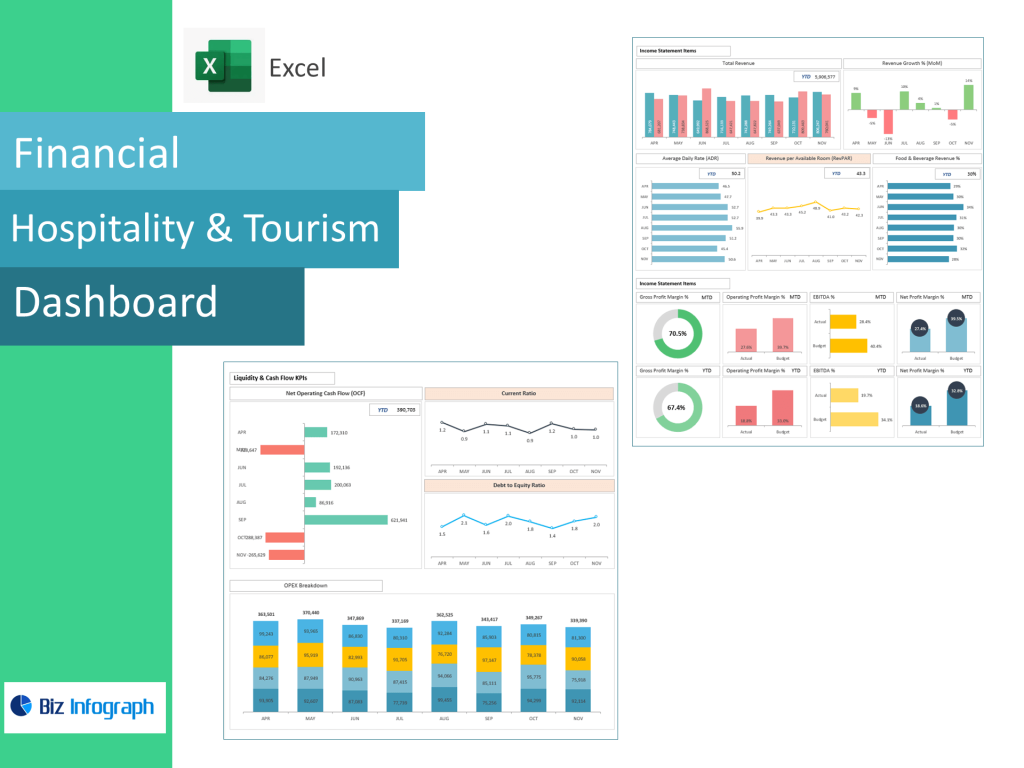
How a Financial Dashboard Supports Hotel Revenue Management
A Hospitality & Tourism Financial Dashboard plays a crucial role in helping hotel managers and revenue management teams make accurate, timely, and data-driven financial decisions. In the fast-paced hospitality sector, demand patterns shift frequently, influenced by seasonal tourism flows, competitor pricing, guest behavior, and global economic trends. A financial dashboard consolidates financial data from various revenue streams—rooms, F&B, spa services, parking, events, and ancillary revenue per guest—into one unified platform. This allows hotel managers to monitor fluctuations in total revenue per available room, assess daily pickup, and track booking lead time with greater precision.
Through integration with revenue management systems, a financial dashboard enables management for hotels to maximize revenue per available room while ensuring the right balance between occupancy and rate. By presenting real-time financial trends, such dashboards help hospitality businesses anticipate booking volumes, adjust pricing strategies, and optimize room inventory. The dashboard also empowers hotel teams to convert raw data into actionable insights, ultimately improving revenue outcomes and overall financial performance. Hotels—from small boutique properties to large hotel chains—use these dashboards to strengthen revenue planning, reduce guesswork, and build more resilient financial models.
Key Metrics and KPIs Used in Hospitality Dashboards
Hospitality dashboards rely on a variety of key metrics and KPIs that measure the financial and operational health of a hotel. These metrics provide actionable insights by helping hotel managers understand where revenue comes from, where it declines, and where optimization opportunities exist. Metrics like revenue per available room (RevPAR), total revenue per available room (TRevPAR), and gross operating profit (GOP) indicate the financial performance of a property. Meanwhile, operational KPIs such as labor cost percentage, booking lead time, and customer lifetime value offer deeper insight into cost efficiency and long-term guest profitability.
Key financial indicators also include net operating income, cost per occupied room, total revenue per guest, and ancillary revenue generated through upsells or on-site services. Hospitality dashboards track guest satisfaction scores as well, since financial performance and guest satisfaction are closely aligned in the hospitality sector. By monitoring these KPIs in real-time, the dashboard gives hotel managers the visibility needed to react to market fluctuations and adjust operational strategies. These performance metrics turn hotel revenue dashboards into powerful decision-making tools, enabling hotels to refine service offerings, pricing models, and internal cost controls.
Real-Time Insights for Hotel Financial Decision-Making
Real-time insights are essential for effective financial decision-making in hospitality. A real-time financial dashboard provides continuous visibility into hotel revenue, cost trends, booking patterns, and occupancy fluctuations, empowering hotel managers with immediate, accurate, and actionable intelligence. Instead of waiting for end-of-month financial statements, decision-makers can react instantly to shifts in demand. For example, if booking lead time shortens unexpectedly, the dashboard alerts the revenue team to adjust pricing dynamically or launch targeted promotions.
Real-time financial data helps hospitality executives respond to operational challenges swiftly, such as rising labor cost percentage or sudden decreases in ancillary revenue per guest. The speed at which these insights are delivered empowers hotel stakeholders to maintain profitability, improve forecasting accuracy, and preserve strong hospitality service standards. With real-time dashboards, management can also detect early warning signs of declining customer lifetime value or satisfaction scores, prompting corrective actions before financial performance declines. Ultimately, real-time insights transform traditional hotel financial management into a proactive, strategic discipline.
Core Components and Structure of a Hotel Financial Dashboard
Essential Hotel Revenue Metrics Included in a Financial Dashboard
A hotel revenue dashboard includes several essential metrics that indicate the financial strength of a property. Among the most important KPIs are revenue per available room, total revenue per available room, average daily rate, occupancy rate, gross operating profit, and ancillary revenue per guest. These metrics help hospitality businesses identify what drives revenue growth and what limits financial performance. Metrics like booking lead and booking lead time help revenue managers understand traveler behavior—including how far in advance guests tend to book and which seasons require more marketing support.
Hotel financial dashboards also include insights into departmental performance across rooms, F&B, events, and recreational services. Tracking the contribution of each revenue center helps hotels diversify income streams and reduce reliance on room revenue alone. Additional metrics like labor cost percentage highlight whether operational costs are aligned with financial targets. With all these KPIs combined in one dashboard, hospitality leaders gain a holistic understanding of financial trends and can make strategic adjustments that improve profitability and operational efficiency.
Dashboard Features That Strengthen Hospitality Management Strategies
Effective hospitality dashboards include features that support strong financial and operational management strategies. These dashboards display financial trends visually, allowing hotel operators to see peaks, declines, and irregularities at a glance. The dashboard provides actionable insights such as early warnings when KPIs fall outside expected thresholds or when booking patterns shift unexpectedly. Hospitality dashboards often include drill-down capabilities, enabling managers to explore financial data by segment—corporate, leisure, group, or OTA bookings.
Advanced dashboards integrate with revenue management systems and hotel management software to automate data updates and reduce manual reporting errors. This automation helps hospitality teams interpret financial data in real time and adjust strategies accordingly. Whether optimizing rate structures, managing distribution channels, or analyzing guest demographics, a strong hospitality dashboard empowers hotel decision-makers with the clarity needed to adapt quickly. These features support long-term strategy development as well, helping hotels align operational goals with broader financial objectives.
Using Key Metrics to Improve Hotel Revenue Performance
When used effectively, key metrics transform hotel financial performance. Metrics like revenue per available room, total revenue per available room, and gross operating profit offer direct insight into how well a hotel is converting demand into revenue. Metrics like booking lead time and customer lifetime value guide revenue managers in shaping pricing strategies, upsell opportunities, and guest retention programs. By tracking these KPIs, hospitality businesses can detect underperforming areas and take corrective action.
Labor cost percentage, for example, may rise during low occupancy periods, signaling the need for workforce optimization. Similarly, if ancillary revenue per guest declines, hotels may revisit their upselling strategies or redesign guest service packages. The dashboard allows hotel managers to adjust distribution strategies as well, improving channel profitability by identifying over-reliance on high-commission OTAs. By continuously analyzing key metrics, hotels improve overall financial stability and operating performance, making revenue management more predictive and data-driven.
Enhancing Financial Performance Through Data Visualization
How Real-Time KPIs Help Hotels Optimize Revenue Management
Real-time KPIs empower hotels to optimize revenue management by offering continuous visibility into market conditions and operational performance. Hospitality dashboards display real-time occupancy updates, revenue changes, and booking pace trends, enabling revenue teams to adjust room pricing, inventory allocation, and promotional strategies immediately. For hotels in competitive markets, these real-time adjustments are essential for capturing last-minute demand and maximizing revenue per available room.
Data visualization simplifies complex hospitality data, turning raw data into actionable insights for revenue teams. Dashboards highlight daily, weekly, and monthly performance trends in a visually intuitive manner, helping hospitality managers understand demand patterns and make confident financial decisions. This real-time clarity gives hotel chains and independent hotels alike the ability to track performance metrics without manual calculations. The result is faster decision-making, improved profitability, and a stronger competitive edge.
Hospitality Dashboards as Tools for Financial Planning and Forecasting
Hospitality dashboards serve as powerful tools for financial planning and forecasting by consolidating key financial and operational data into a single platform. Financial planning in the hospitality sector depends on accurate forecasting of demand, guest spending behavior, and booking lead patterns—metrics the dashboard tracks automatically. By analyzing historical trends and real-time activity, hotel revenue teams can project future occupancy, revenue per available room, and total revenue per available room.
Dashboards also assist with budget planning by showing whether labor cost percentage, operational expenses, or departmental revenue are aligned with financial goals. Forecasting tools built into these dashboards help hospitality businesses anticipate market shifts and prepare management strategies accordingly. For example, if booking pace slows for an upcoming season, the dashboard alerts revenue teams to adjust marketing efforts or modify pricing tiers. Through intelligent forecasting, hospitality dashboards enhance long-term financial stability and growth.
Turning Financial Data Into Actionable Insights for Hotel Leaders
Hotel leaders rely on dashboards to turn complex financial data into actionable insights that drive smarter management decisions. The dashboard gives hotel managers a clear understanding of revenue mix, cost structure, guest satisfaction trends, and financial vulnerabilities. Rather than manually analyzing raw datasets, managers receive curated insights that highlight performance strengths and weaknesses. These insights enable quicker responses to market changes, such as adjusting loyalty programs, refining service offerings, or improving operational efficiency.
Dashboards help hospitality leaders make informed decisions by surfacing meaningful patterns—like which booking sources yield the highest lifetime value or which channels contribute to declining profitability. By presenting data visually and clearly, the dashboard empowers hotel executives to develop stronger, more sustainable financial and operational strategies. Ultimately, these insights support a data-driven culture that helps hospitality businesses stay competitive, profitable, and guest-centric.
For ready-to-use Dashboard Templates: