
Why Healthcare Dashboards Package Matter for Analytics
How healthcare dashboards improve data-driven decision-making
Modern healthcare organizations operate in highly complex environments where decisions must balance quality of care, operational efficiency, patient satisfaction, and financial performance. A well-designed healthcare dashboard enables healthcare professionals and administrators to make informed decisions by consolidating healthcare data into a single, reliable view. Instead of relying on fragmented reports, dashboards provide real-time visibility into key healthcare KPIs such as bed occupancy rate, patient flow, length of stay, and patient satisfaction scores. With analytics dashboards, leaders can quickly identify trends, risks, and bottlenecks across healthcare facilities. This data-driven approach supports faster response times, better resource allocation, and improved patient outcomes—key priorities in modern healthcare management.
Turning healthcare data into actionable performance metrics
Healthcare systems generate vast amounts of data from clinical systems, operations dashboards, finance systems, and HR platforms. Without structure, these data sets remain underutilized. A dashboard template transforms raw patient data and operational data into actionable performance metrics using clear visualization and data analysis. For example, dashboards can convert admission and discharge data into patient flow insights or cost data into cost-per-patient indicators. By highlighting key healthcare metrics visually, dashboards help identify areas for improvement such as extended length of stay or declining patient satisfaction. Ultimately, dashboards offer healthcare business intelligence that turns complex data into clear actions, enabling continuous improvement across clinical and operational functions.
Types of Healthcare Dashboards in Modern Organizations
Clinical dashboards for quality of care monitoring
Clinical dashboards focus on patient outcomes, safety, and quality of care. They track clinical KPIs such as infection rates, readmissions, adverse events, and patient satisfaction indicators. A Clinical Operations Dashboard allows healthcare providers to monitor performance in real time and compare outcomes across departments or facilities. By visualizing patient data and quality metrics, healthcare professionals can detect issues early and intervene before problems escalate. Healthcare dashboards are essential in ensuring adherence to best practices in healthcare and maintaining high standards of patient care. With Power BI healthcare dashboards, clinicians gain self-service access to insights that support evidence-based care and continuous quality improvement.
Operational dashboards for efficiency and resource optimization
Operational dashboards are designed to improve efficiency across healthcare facilities by tracking metrics such as bed occupancy, patient flow, staff utilization, and turnaround times. The Healthcare Resource & Operational Efficiency Dashboard plays a critical role here by highlighting how resources are used and where inefficiencies exist. For example, dashboards can show bottlenecks in emergency departments or underutilized beds in certain wards. By integrating data from various sources, operational dashboards provide a holistic view of clinical and operational performance. This helps healthcare administrators optimize workflows, reduce delays, and improve overall service delivery while maintaining quality of care.
Financial dashboards for healthcare finance and performance
Healthcare finance is complex, involving revenue cycle management, cost control, and regulatory compliance. Financial dashboards track KPIs such as healthcare costs, cost per case, revenue cycle performance, payer mix, and financial performance trends. The Healthcare Financial Performance Dashboard provides decision-makers with clear insights into financial health, enabling better budgeting and forecasting. By linking financial data with operational and clinical metrics, healthcare organizations can understand the financial impact of care delivery decisions. These dashboards support transparency, accountability, and sustainability in the healthcare industry, ensuring resources are used effectively without compromising patient care.
What Makes a Strong Healthcare Dashboard Template
Key healthcare KPIs and metrics to track
A strong healthcare dashboard template must focus on key performance indicators that reflect both patient outcomes and organizational efficiency. Core healthcare KPIs include bed occupancy rate, average length of stay, patient flow metrics, patient satisfaction scores, cost per patient, staff utilization, and revenue cycle indicators. Dashboards should also track quality-of-care metrics such as readmission rates and clinical compliance indicators. By presenting these key metrics in a structured format, dashboards allow healthcare professionals and administrators to monitor performance continuously. Consistent KPI tracking helps identify trends, benchmark performance, and ensure alignment with strategic goals across healthcare organizations.
Best practices in healthcare dashboard design
Effective healthcare dashboards follow best practices in healthcare design: clarity, accuracy, and usability. Dashboards should present data in a simple, intuitive layout with clear labels, color-coded indicators, and logical grouping of metrics. Best practices in healthcare dashboard design also include role-based views, ensuring clinicians, managers, and finance teams see relevant information. Data governance and validation are critical to ensure accuracy and trust in reported metrics. Dashboards should support drill-down analysis while maintaining a clean overview. When designed properly, dashboards provide actionable insights without overwhelming users, supporting better decision-making at all organizational levels.
Power BI dashboard features for healthcare analytics
A Power BI healthcare dashboard offers advanced capabilities for healthcare analytics, including interactive visuals, drill-downs, and integration with multiple data sets. Power BI dashboards support self-service dashboards, enabling healthcare professionals to explore data without relying on IT teams. Features such as real-time data refresh, secure access controls, and seamless integration with clinical and financial systems make Power BI a powerful dashboard software choice. With Power BI, healthcare organizations can build tailored dashboards that combine clinical, operational, and financial insights into one platform—supporting data analysis, data visualization, transparency, and continuous improvement.
Clinical Performance & Quality of Care Dashboard
Clinical KPIs to monitor patient outcomes and safety
The Clinical Operations Dashboard focuses on monitoring patient outcomes, safety, and clinical performance. It tracks key metrics such as readmission rates, infection rates, medication errors, and patient satisfaction scores. By visualizing these indicators, healthcare providers can quickly identify trends and risks that may affect quality of care. Dashboards provide clinicians with timely insights that support proactive interventions and adherence to clinical best practices. With integrated patient data, clinical dashboards help improve coordination of care and ensure that quality-of-care standards are consistently met across departments and facilities.
Using data analytics dashboards to improve quality of care
Analytics dashboards play a vital role in improving quality of care by highlighting patterns and variations in clinical performance. For example, dashboards can reveal correlations between staffing levels and patient outcomes or identify departments with longer-than-average length of stay. By leveraging healthcare analytics, organizations can test improvement initiatives and measure their impact over time. These insights enable healthcare professionals to refine care pathways, reduce variability, and enhance patient outcomes. Ultimately, analytics dashboards support a culture of continuous improvement, where data-driven insights guide clinical decision-making and elevate standards of care.
Operational Efficiency & Management Dashboard
Operational metrics for workflow and capacity management
The Healthcare Resource & Operational Efficiency Dashboard focuses on workflow optimization and capacity management. It tracks operational metrics such as bed occupancy, patient flow, admission and discharge timing, and resource utilization. These insights help healthcare facilities manage capacity effectively, especially during peak demand periods. Dashboards enable administrators to anticipate bottlenecks, balance workloads, and improve patient throughput. By integrating data from various sources, operational dashboards provide a real-time view of hospital operations, supporting faster decision-making and improved service delivery.
Operations dashboard insights to optimize performance
Operations dashboards help healthcare administrators identify inefficiencies and optimize performance across departments. For instance, dashboards can show where delays occur in patient flow or where staffing shortages impact service levels. By analyzing dashboard metrics, leaders can implement targeted improvements such as process redesign or resource reallocation. These dashboards provide actionable insights that drive operational excellence while maintaining quality of care. Over time, consistent use of operations dashboards leads to reduced wait times, better patient experiences, and more efficient use of healthcare resources.
Healthcare Financial Performance Dashboard
Financial performance KPIs for healthcare organizations
The Healthcare Financial Performance Dashboard provides visibility into financial KPIs such as revenue cycle performance, cost per case, payer mix, and operating margins. Healthcare organizations use these dashboards to monitor financial health and identify areas where costs can be controlled without compromising care quality. By linking financial metrics with clinical and operational data, dashboards offer a comprehensive view of performance. This enables finance teams and executives to make informed decisions about budgeting, investment, and resource allocation in a complex healthcare environment.
Power BI healthcare dashboard for financial analysis
Using a Power BI dashboard for healthcare finance allows organizations to conduct detailed financial analysis with interactive visuals and drill-down capabilities. Finance teams can explore trends in healthcare costs, analyze revenue cycle efficiency, and evaluate financial performance across departments or facilities. Power BI dashboards support secure access and integration with accounting systems, ensuring accurate and timely reporting. These dashboards empower healthcare leaders to align financial strategy with clinical and operational priorities, supporting long-term sustainability.
Patient Satisfaction & Experience Dashboard
Patient satisfaction metrics and experience tracking
Patient experience is a critical measure of healthcare performance. The patient dashboard tracks patient satisfaction metrics, feedback scores, complaint trends, and service quality indicators. By monitoring these metrics, healthcare providers can understand patient perceptions and identify opportunities to enhance care experiences. Dashboards provide a clear view of satisfaction trends across services, locations, and time periods. This enables targeted improvements that directly impact patient trust and loyalty.
Performance dashboards for continuous improvement
Performance dashboards support continuous improvement by tracking key performance indicators over time and highlighting progress toward strategic goals. By combining clinical, operational, and patient experience data, dashboards offer a comprehensive performance dashboard view. Healthcare professionals and administrators can use these insights to test improvement initiatives, measure outcomes, and refine strategies. With self-service dashboards and integrated analytics, organizations foster a culture of transparency and accountability—driving better outcomes for patients and providers alike.
Implementing Healthcare Dashboard Packages Successfully
Dashboard software selection and Power BI implementation
Selecting the right dashboard software is critical to success. Power BI is widely used in healthcare due to its scalability, security, and integration capabilities. During implementation, organizations should focus on data integration, user training, and role-based access. A structured implementation ensures dashboards align with clinical and operational workflows and deliver value quickly.
Data analysis, governance, and ongoing optimization
Successful dashboards require strong data governance, regular data validation, and ongoing optimization. Healthcare organizations should establish ownership for data sets, define healthcare KPI standards, and review dashboard performance regularly. Continuous refinement ensures dashboards remain relevant and accurate as organizational needs evolve.
The 4 Dashboards Included in This Healthcare Package
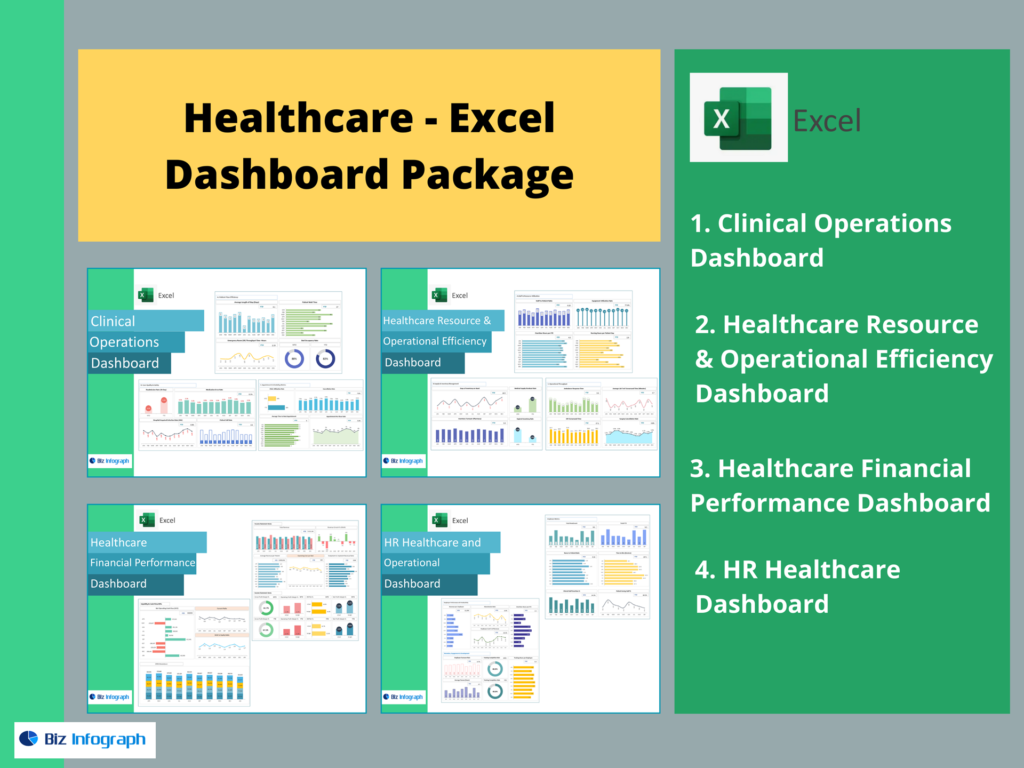
This Healthcare Dashboard Package includes: Clinical Operations Dashboard, Healthcare Resource & Operational Efficiency Dashboard, Healthcare Financial Performance Dashboard, and HR Healthcare Dashboard. Together, they provide a comprehensive analytics solution covering clinical quality, operational efficiency, financial performance, and workforce management—supporting data-driven excellence across the healthcare industry.
For ready-to-use Dashboard Templates: