
Understanding a Risk, Compliance And Back-Office Operations Dashboard
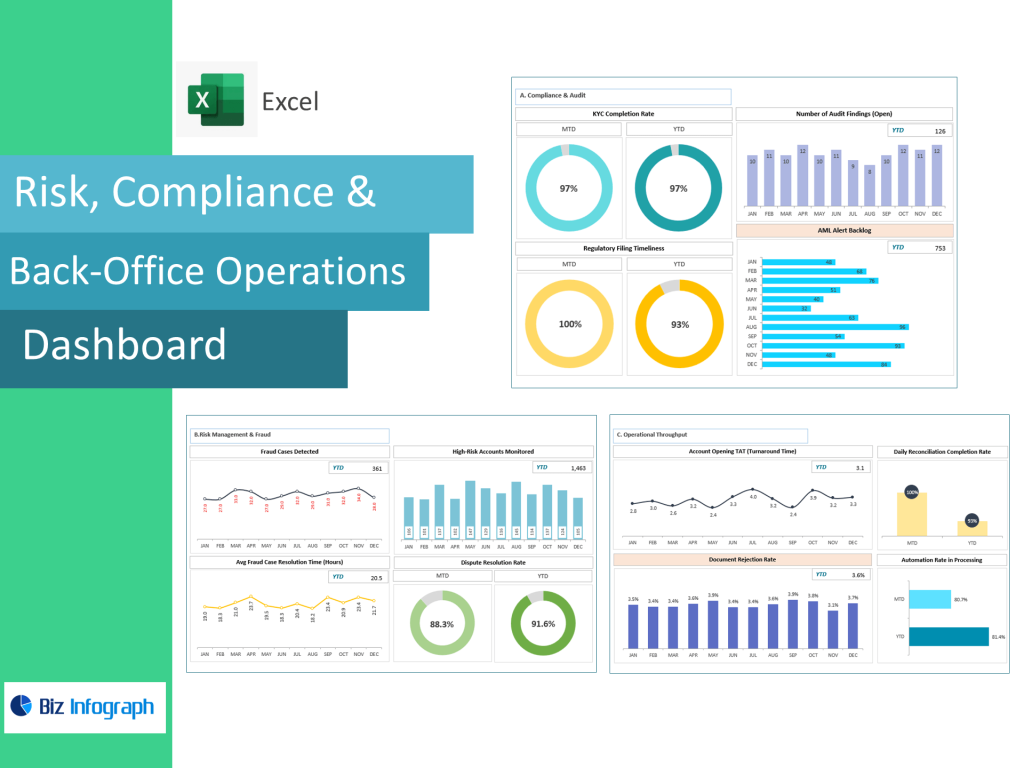
How a Risk Management Dashboard Helps Track Exposure and Asset Risk
A risk management dashboard provides risk managers with a centralized, data-driven interface to track exposure, vulnerability points, and ongoing mitigation efforts. The dashboard contains risk metrics such as asset risk, threat likelihood, control strength, and severity categories that shape decision-making. Through real-time visualization, a risk management dashboard gives organizations an overview of risk across back-office systems, applications, internal processes, and operational functions. The dashboard gives leaders the ability to track cyber risk, financial exposure, workforce risk, and vendor-related threats as they evolve. Risk managers can apply risk mitigation strategies more effectively because the dashboard offers a comprehensive view of incidents, trending alerts, and probable future vulnerabilities. Asset-level monitoring is especially important in environments with cloud assets because unauthorized access or misconfiguration often increases exposure. Over time, this dashboard strengthens organizational resilience and safeguards business operations against operational, cyber, and compliance failures.
Compliance Dashboard Reporting to Measure Compliance Score and Remediation Progress
A compliance dashboard provides insights into how compliant an organization is with regulatory frameworks, industry rules, and internal governance standards. Metrics such as compliance score, control completion rates, internal audit status, and remediation task aging help teams stay aligned with their legal obligations. The dashboard gives compliance officers a comprehensive view of where gaps exist and which remediation activities require prioritization. With compliance metrics displayed clearly, organizations can see which policies are overdue, which controls are incomplete, and how risk exposure connects to compliance posture. This supports data-driven compliance decisions rather than reactive reporting. Real-time updates allow risk and compliance teams to respond quickly when compliance drift occurs. By visualizing remediation deadlines, audit findings, and governance maturity, a compliance dashboard strengthens operational integrity and decreases the likelihood of regulatory penalties. Over time, strong compliance reporting brings financial, operational, and reputational gains.
What an Executive Dashboard Gives Leaders for Operational Decision-Making
An Risk, Compliance And Back-Office Operations dashboard summarizes core business health indicators into visual, high-level insights for leadership teams. This dashboard gives executives a real-time overview of risk, compliance, and operational efficiency, allowing faster decisions with less manual analysis. Through trending analytics, executives see whether back-office processes are improving, stagnating, or degrading. The dashboard contains financial impact indicators, remediation deadlines, incident response speed, and control performance status—all critical for strategic clarity. Risk managers and compliance leaders can use the dashboard to predict disruption probability, model risk-to-cost outcomes, and measure the financial return of mitigation plans. Executives no longer rely on scattered reports or anecdotal information—the executive dashboard creates unified visibility that aligns security operations, risk management, and compliance governance. Ultimately, this dashboard improves strategic accountability and ensures risk decisions are communicated quickly across departments.
Key Metrics and KPIs for Risk & Compliance Monitoring
Essential Risk and Compliance KPIs to Monitor Continuously
Risk metrics and compliance metrics must be monitored continuously to protect business continuity. Common KPIs include risk likelihood, impact severity, incident volume, response time, policy adherence percentage, and regulatory compliance score. These key measurements help risk managers detect abnormal patterns and deploy remediation before losses occur. Monitoring KPIs in real time reduces audit failures, cybersecurity exposure, and operational weakness. A well-designed dashboard gives leadership the ability to measure whether internal controls are improving outcomes or merely sustaining status-quo risk. Compliance KPIs also track audit completion rates, vendor certifications, and data privacy alignment with frameworks like HIPAA or GDPR. By maintaining KPI visibility at all times, organizations avoid blind-spots that escalate risks unexpectedly. Continuous KPI monitoring also leads to higher ROI because strategic decisions can be based on real-time analytics instead of outdated reports.
Metrics for Asset Risk, Cloud Assets, and Policy Violations
Organizations must track asset risk to secure data, intellectual property, and business continuity. The dashboard includes metrics for device vulnerabilities, misconfigured cloud assets, unauthorized access events, and unsupported software versions. A real-time dashboard gives organizations a complete picture of asset-level weakness so they can respond before exploitation occurs. Risk management dashboards reveal system health and policy violation trends that often precede larger incidents. Risk metrics relating to outdated credentials, admin privilege spikes, and inactive device status also surface system fragility. Cloud assets require increased monitoring due to distributed access and multi-environment exposure. Operational efficiency depends on automated alerting and visual reporting, not manual review. Therefore, asset-risk tracking must be dashboard-driven, proactive, and continuously updated. Once vulnerabilities are identified, remediation efforts automatically reduce exposure and help maintain business continuity.
How the Dashboard Template Supports Data Visibility and Risk Analysis
A dashboard template accelerates deployment and ensures consistent measurement across departments. Instead of designing visual layouts manually, organizations can use templates with predefined risk metrics, compliance charts, and remediation workflows already built in. A template offers structure for incident response tracking, audit trail reporting, and compliance score visualization. The dashboard gives risk managers instant clarity without extensive configuration. With templated layouts, teams can import data through spreadsheets or Google Sheets, connect APIs to log data feeds, and begin monitoring in minutes instead of weeks. A standardized template also improves collaboration across business units because everyone interprets risk signals using the same visual logic. This reduces reporting confusion and ensures decisions are data-driven. Over time, template-based dashboards become institutional governance tools that scale with organizational maturity.
Dashboard Templates, Integration, and Implementation
Using a Dashboard Template for Faster Setup and Repeatable Reporting
A dashboard template enables faster implementation by removing the complexity of layout design and metric structuring. Instead of recreating dashboards for each reporting cycle, risk managers load new datasets into the same template for repeatable, automated insight. Templates can be customized for compliance scorecards, operational risk charts, and real-time asset monitoring. This creates continuity across reporting cycles while improving speed and reliability. A template-based approach is also cost-efficient because organizations spend less time formatting and more time analyzing risk. The dashboard contains visualization modules for violations, incidents, and remediation outcomes, enabling leadership to understand trends quickly. Teams benefit from structured reporting that supports long-term regulatory compliance and operational efficiency.
Integration Options Including API Connections to Security & Compliance Tools
API-based integration allows dashboards to pull real-time data from cybersecurity systems, compliance logs, SIEM alerts, ticketing platforms, and cloud asset registries. An operations dashboard becomes most powerful when connected to external tools instead of relying on static reports. With API integration, risk metrics update continuously without manual upload. Integrations enhance incident response by streamlining alert investigation and control execution. Dashboards also integrate with Google Sheets for lightweight reporting and manual override input. The ability to integrate tools ensures risk analytics represent live reality—not snapshots. This integration eliminates reporting delays and accelerates remediation cycles.
Implementation Strategies to Navigate Risk Management at Scale
Implementation must focus on scalability, automation, and workflow alignment. Deployment begins with defining risk metrics that matter most, configuring data ingestion, and mapping controls. A well-implemented dashboard gives clear navigation, intuitive filtering, and minimal training friction. Organizations must evaluate user access requirements, reporting cadence, and cloud asset visibility. Implementation also requires incident response alignment—dashboards should trigger alerts based on risk thresholds. At scale, automation generates substantial ROI by eliminating recurring manual reporting tasks. Strong implementation results in operational efficiency, reduced exposure, and more resilient back-office risk governance.
Management Dashboard and Interface Usability
Intuitive Interface Features That Improve Dashboard Usability
An intuitive dashboard interface increases adoption, accuracy, and decision-making velocity. The dashboard is designed to visualize risk exposure clearly through color-coded severity indicators, summary widgets, and filtered detail views. Usability enhances ability to interpret compliance information without technical complexity. The interface should support drag-and-drop chart placement, customizable layout panels, and annotation for investigation notes. A clear interface reduces training needs and allows new analysts to navigate risk systems confidently. When usability improves, risk managers respond faster to early warning signals. This reduces asset risk and mitigation delay.
Management Dashboard Navigation for Monitoring Risk and Compliance
Navigation determines how easily stakeholders interact with risk and compliance insights. A management dashboard allows top-down navigation from executive summaries to granular root-cause analysis. Risk managers can trace exposure from high-level trend charts into asset-specific threat logs. Navigation must support both overview of risk and detailed investigation without interface friction. Users should pivot between compliance dashboards, operations dashboards, and remediation progress in one system. Smooth navigation accelerates incident response and reduces audit error. Good navigation multiplies dashboard ROI because faster interpretation drives faster action.
Dashboard Gives Real-Time Insights for Risk, Compliance, and Back-Office Operations
A real-time dashboard gives organizations live snapshots of exposure, remediation backlog, operational uptime, and compliance score. Real-time insights into your cybersecurity posture allow mitigation before escalation. The dashboard contains streaming risk metrics from cloud assets, data logs, and policy enforcement tools. This real-time view reduces uncertainty and helps risk managers respond decisively. Back-office functions benefit through faster approval cycles, streamlined governance, and automated documentation.
Driving ROI With a Risk & Compliance Dashboard
Improving ROI Through Compliance Automation and Risk Reduction
ROI increases when automation reduces labor cost and prevents high-impact breaches. Compliance dashboard alerts trigger automated workflows for evidence collection, remediation tickets, and audit proofing. Automation reduces compliance fatigue and ensures risk reduction efforts align with strategic budgets. As remediation time decreases, operational efficiency improves—boosting ROI organically.
How Risk Management Dashboards Strengthen Decision-Making Across Departments
Risk dashboards unify data across departments, eliminating siloed reporting. A cross-departmental dashboard format allows finance, IT, legal, and audit to collaborate on risk mitigation strategies. Shared visibility improves communication, reduces duplicated work, and ensures decisions are data-driven.
Compliance Dashboard Intelligence for Long-Term Remediation and Governance
Long-term remediation success depends on continuous monitoring, maturity scaling, and governance reinforcement. A compliance dashboard provides intelligence that highlights weak controls, policy updates, and audit closure trends. Over time, this intelligence drives sustainable compliance culture.
For ready-to-use Dashboard Templates: